
Melbourne Cup Betting in New Zealand in 2026
 Available in US
Current as of 30 October 2026. The figures and legal references below were checked against the Racing Industry Act 2020 (as amended in 2025), the Department of Internal Affairs guidance and the TAB NZ and Betcha app listings.

The Melbourne Cup stops the country for a few minutes on the first Tuesday in November. The 2026 running is scheduled for 3 November, the 166th edition, and the field will line up at Flemington at distance 3,200 metres under handicap weights set by the VRC Handicapper. A New Zealand punter who wants a wager on it has a narrower set of choices than the marketing around “best Melbourne Cup betting sites” suggests. This page works through what the market actually offers in New Zealand, what the law allows, and what a bonus or a price boost really costs the bettor who claims one.
Table of Contents
- What the Melbourne Cup Is and Why It Matters for NZ Punters
- The New Zealand Betting Market: A Monopoly by Law
- Responsible Gambling: What TAB NZ Provides and Where to Get Help
- Bonuses, Free Bets and “Boosted Odds”: What the Marketing Word Actually Means
- Predictions, Tips and “Best Bets”: What the Page Does and Does Not Promise
- Bet Types and How the Odds Work
- The Melbourne Cup in the NZ Sporting Calendar
- The New Zealand Landscape: TAB NZ and the Offshore Brands
- The Reviewed Bookmakers
- The Margin and What It Costs
- What a Bonus Bet Actually Costs
- The Cup Card, in Practice
- What Happens After the Race
- Taxation: What a New Zealand Punter Owes
- Frequently Asked Questions
What the Melbourne Cup Is and Why It Matters for NZ Punters
The Cup is a Group 1 handicap over 3,200 metres at Flemington Racecourse, open to three-year-olds and older. Weights are set by the VRC Handicapper with a minimum of 50 kg, and the field is capped at 24 starters for safety, although the largest field on record was 39 in 1890. The race has been run since 1861, was originally two miles and switched to its current distance when Australia metricated racing in 1972. The fastest Cup on the clock remains Kingston Rule’s 3:16.3 from 1990. Prize money was A$10 million in 2025, up from A$8.56 million the year before.

For a New Zealand punter, the race is one of the few Australian sporting events that draws genuine mainstream attention across the Tasman, and a TAB NZ win-to-place market on Cup Day typically runs to several hundred different betting products across the card. That volume of markets is the reason the Cup earns its own previews: it is the one day of the year when the racing product genuinely dominates over sport.
The race in figures
| Detail | Value |
|---|---|
| First run | 1861 |
| Distance (since 1972) | 3,200 metres |
| Minimum weight | 50 kg |
| Field cap | 24 starters |
| Record field | 39 (1890) |
| Track record | 3:16.3 (Kingston Rule, 1990) |
| 2025 prize money | A$10 million |
| 2026 scheduled date | 3 November 2026 |
| 2026 running | 166th |
The New Zealand Betting Market: A Monopoly by Law
Here is the point many offshore comparison pages bury: since 28 June 2025, the only provider that may lawfully offer racing and sports betting to a person in New Zealand is TAB NZ. Section 74AAA of the Racing Industry Act 2020, inserted by the Racing Industry Amendment Act 2025, prohibits any other person from offering racing betting, sports betting or other racing or sports betting to a person in New Zealand, regardless of where the operator is resident or incorporated. The Department of Internal Affairs told unlicensed providers serving New Zealand customers to withdraw with immediate effect.
TAB NZ operates two online brands: TAB itself and Betcha. They are the same operator group, not rivals. Betcha was first released as a New Zealand app on 6 August 2024 and is published by Entain New Zealand Limited under TAB NZ’s structure. Entain runs the TAB business under a 25-year agreement signed in 2023 that gives Entain a 50/50 share of gross profits, with at least $150 million a year going to TAB NZ for the first five years and a one-off $100 million payment to the racing sector.
There is no licence to apply for and no bookmaker licence register, because there is only one lawful provider. That is the single most important fact for a New Zealand punter comparing offers: the entire offshore “Melbourne Cup betting sites” market operates outside New Zealand law, and the legal exposure sits with the operator, not the player. Section 19(4) of the Gambling Act 2003 says an individual may not be convicted for placing a bet with an offshore operator in breach of section 74AAA, so the practical risk for a New Zealand punter who strays offshore is not prosecution. It is the absence of the harm-minimisation framework, complaints route and payout protections that TAB NZ carries.
What TAB NZ may offer
TAB NZ is a fixed-odds and tote (pool) operator. Its published betting rules cover Win, Place, Each Way, Quinella, Exacta, Trifecta, First Four, Double, Treble, Daily Double, Running Double, Quaddie, Big6, Multis and Same Game Multis. Live betting is available through the TAB NZ apps. There is no statutory per-bet cap and no published restriction on in-play markets, so any cap is operator-level and lives in TAB NZ’s own terms.
What TAB NZ may not offer
There is no lawful New Zealand betting exchange, and spread betting is outside TAB NZ’s sports-betting definition. Bets on politics and novelty markets are not established as part of TAB NZ’s published product set. Greyhound racing is closing in stages from 1 August 2026, and from that date offshore operators may not take bets on greyhound races either. The Online Casino Gambling Act 2026 licenses online casino gambling only; it does not license sports betting, and TAB NZ’s winning the right to apply for a casino licence does not extend the betting monopoly.
Responsible Gambling: What TAB NZ Provides and Where to Get Help
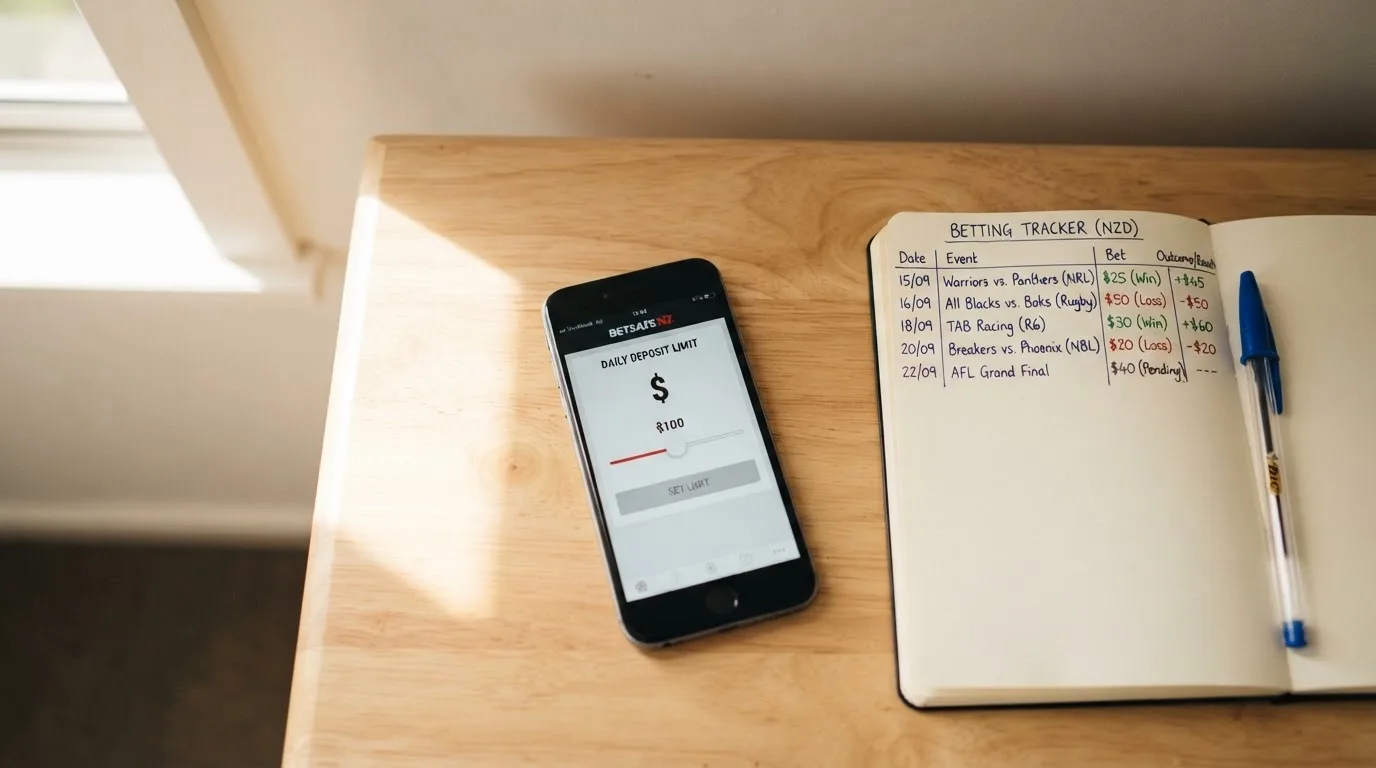
TAB NZ’s app, sold on the New Zealand App Store under the name New Zealand Racing Board and first released on 8 September 2014, carries the safer-gambling tools the regulator expects: deposit limits, time-outs and self-exclusion. A self-exclusion applies across both TAB NZ brands, so excluding from TAB excludes from Betcha as well.
The age for betting with TAB NZ is 18. Betting under 18 is an offence under section 89 of the Racing Industry Act 2020. The app carries a 17+ App Store age rating but states that customers must be 18 or over to bet. Land-based casino gambling has a higher age of 20, and the two thresholds must not be conflated.
The free New Zealand Gambling Helpline is 0800 654 655, with a text line at 8006. Safer Gambling Aotearoa is the broader public-facing body for harm-minimisation information. TAB NZ contributes to the Problem Gambling Levy at 0.74%, in force from 1 July 2025 to 30 June 2028.
There is no single national online-betting exclusion register. The exclusion register the casino law will require applies to online casinos, not to sports or racing betting. For a punter who wants a self-exclusion that holds across the offshore brands they may have signed up with in the past, the practical answer is to use the multi-operator self-exclusion tools those brands offer in their own terms, and to recognise that none of them binds a New Zealand punter under New Zealand law.
Bonuses, Free Bets and “Boosted Odds”: What the Marketing Word Actually Means
Every “Melbourne Cup bonus bet offers” page in the wider market works the same way: a headline figure on a deposit match or a free bet, and a footnote that turns the headline into a number with an asterisk. The job here is to read the footnote for you.
The four shapes the offer takes, in plain words:
A deposit match is the operator matching some percentage of your deposit with bonus funds. A “100% match up to $100” is the standard form: deposit $100, receive $100 in bonus money, but the bonus sits in a separate balance and cannot be withdrawn until wagering requirements are met. The deposit is yours; the bonus is the operator’s, until you clear it.
A free bet is a stake the operator gives you to place, but the stake is usually not paid back with a win. A $10 free bet at $3.00 odds returns $30, not $40: the $10 stake vanishes. That is the standard “free bet” treatment and the reason free bets are priced as half their face value in any honest comparison.
A risk-free bet is marketing for the same free-bet mechanic. “Risk-free” means: if your first bet loses, the operator refunds the stake as a free bet, not as cash. The word “free” is doing a lot of work there.
A boosted odds or price boost is the operator offering a higher price than the market for a specific selection. A boosted $4.00 on a horse that is otherwise $3.50 looks generous, and it is, but only if the boosted price is the one you actually receive at bet placement. Some boosts apply only to single bets, not to multis; some cap the stake that gets the boost; some pay the winnings as bonus money with wagering attached. The fine print is the offer.
What the offers cost
The arithmetic a punter is advised to run on any TAB NZ “bonus bets” promotion is the same arithmetic that applies to any bookmaker: how much do I have to bet, at what minimum price, before the bonus becomes withdrawable cash, and by what deadline.
TAB NZ’s bonus bet terms sit behind login and vary by promotion, so no single wagering multiple can be stated. A punter who intends to claim a TAB NZ bonus bet on Cup Day is advised to read the specific promotion’s terms before staking, focusing on the wagering multiple, the minimum odds, the eligible markets and the expiry date. TAB NZ’s own terms are the only authoritative source; no third-party summary is advised to override them.
For the broader offer market: a free bet whose stake is not paid back is worth approximately the free-bet amount multiplied by (odds minus 1) divided by odds, then scaled by the payout share of the market. A $10 free bet at $3.00 odds, on a market with a 95% payout share, is worth roughly $10 × 2.00 ÷ 3.00 × 0.95 = $6.33 in expected value. The free bet is not worth $10; it is worth what it returns on average across many uses.
Predictions, Tips and “Best Bets”: What the Page Does and Does Not Promise
The search results for “Melbourne Cup 2026 best bets” and “Melbourne Cup betting tips” run into the thousands every spring. None of them can tell you who will win the 2026 Melbourne Cup, and any page that claims it can is selling you certainty that does not exist. The race is a handicap with a 24-horse field, weights set by the VRC Handicapper, and a distance that grinds out form in a way that defeats single-factor models. The market price on each runner is the market’s collective view of that runner’s chance, after the bookmaker’s margin, and the bookmaker is not your enemy on form, but the margin is real money that does not get refunded on a loser.
What a serious pre-Cup analysis can do is help you compare the market’s price on a runner to the runner’s actual chance of winning, and to spot cases where the price looks wide. That is the only honest framing of “best bet for Melbourne Cup”: a price that is wider than the runner’s chance, in a market where the margin is known, with a stake sized to the punter’s bankroll.
The punter’s bankroll is the part of the analysis that gets the least attention and does the most work. A punter with $200 to bet across the Cup carnival is advised not to stake $50 on a single runner at $6.00, regardless of how strong the form looks. The same selection at $4.00 with a $25 stake, on a market with a known margin, gives a different risk profile and a different expected outcome.
What “best bets” pages typically get wrong
The common errors across the tipster market are the same year after year: a short price on the favourite is treated as a “safe” bet when the favourite’s chance of winning in a 24-horse handicap is rarely above 15% and is often below 10%; an each-way bet is treated as a hedge when in fact the place terms typically pay a quarter or a fifth of the win dividend and the place portion is the part that loses money over a season; a tip from a tipster with a 12% return-on-investment record is sold as a winning system when the same record, applied across hundreds of punters, produces more losers than winners.
The Melbourne Cup is the one race of the year where these errors compound, because the volume of betting and the visibility of the result make every loser memorable. The honest framing for a New Zealand punter looking for “best bets for Melbourne Cup” is to read the form, read the market, and stake within a bankroll. The honest framing for a New Zealand punter looking for “Melbourne Cup 2026 best bets” is that nobody selling a tip is guaranteed to know the answer.
Bet Types and How the Odds Work
A Melbourne Cup betting market at TAB NZ is a set of prices, one per runner, with the bookmaker’s margin baked into the spread. Understanding how those prices are built is the only way to compare a TAB NZ price to a quoted “best odds” elsewhere, which constitutes an unlawful option under New Zealand law.
Win, place and each way
A win bet pays the dividend if the runner finishes first. The return is stake multiplied by the win odds.
A place bet pays if the runner finishes in the place positions, typically first, second and third in a field of eight or more. The return is stake multiplied by the place odds, which are a fraction of the win odds (commonly a quarter in New Zealand and Australian racing, with the place paying for three positions in fields of eight or more, two positions in smaller fields).
An each way bet is two bets of equal stake: one on the runner to win, one on the runner to place. A $10 each way at $10.00 win odds and $2.50 place odds costs $20 in total and pays $100 if the runner wins ($10 × $10.00) plus $25 if it places ($10 × $2.50). If the runner finishes second, the win portion is lost and the place portion pays $25, a net loss of $20 minus the $25 place return. Each way is not a hedge; it is a structural bet with a built-in margin and a real cost to the punter.
Exotics: quinella, exacta, trifecta, first four
A quinella picks the first two runners in any order. An exacta picks the first two in order. A trifecta picks the first three in order. A First Four picks the first four in order. Each step up in difficulty multiplies the potential payout but shrinks the actual chance of winning, and the bookmaker’s margin on exotics is typically wider than the margin on win markets. A $1 trifecta on a 24-horse field has 24 × 23 × 22 = 12,144 possible combinations, and the operator’s take is a slice of every combination.
Multis and same-game multis
A multi or multi bet combines legs from different events: the prices multiply, and the bet wins only if every leg wins. A same-game multi (SGM) does the same within a single event. Both are high-margin products for the bookmaker: the more legs in the multi, the wider the margin, even when the individual legs look fairly priced. A punter who builds a six-leg multi at $1.20 per leg is paying for a $2.99 return, but the implied probability of the combined outcome is roughly 33%, not 33.4% as the multiplied price suggests. The difference is the margin, and it compounds with every leg.
How a bookmaker’s margin sits inside a price
A bookmaker’s margin is the slice of every dollar bet that the operator keeps, on average, across all outcomes of a market. For a two-way market with decimal odds of 1.90 on both sides, the calculation is: payout share = 1 ÷ (1/1.90 + 1/1.90) = 1 ÷ (0.5263 + 0.5263) = 1 ÷ 1.0526 ≈ 0.95. The margin is 1 minus the payout share, so 1 − 0.95 = 0.05, or 5%. That is the slice the bookmaker keeps of every dollar bet on this market, before any individual punter’s results are paid out.
For a typical Melbourne Cup win market, the bookmaker’s margin is wider than 5% because the field is 24 runners, not two, and each runner’s price carries a slice of margin. A market where the prices sum to 110% (the implied probabilities total more than 100%) has a margin of 10%. A market where the prices sum to 120% has a margin of 20%. The wider the sum above 100%, the more the punter pays for the privilege of betting.
The practical read for a punter: the shorter the favourite, the tighter the margin on the favourite itself and the wider the margin on the rest of the field. A favourite at $4.00 in a 24-horse field with a 115% book is a different proposition from the same favourite at $4.00 in a field with a 105% book, and the difference is the operator’s take, not the favourite’s chance.
The Melbourne Cup in the NZ Sporting Calendar
The Cup is one of three or four events a year that the average New Zealand punter actually plans around. The others are the NRL and Super Rugby Pacific season openers, the All Blacks tests, the Warriors matches and the Melbourne spring carnival more broadly. The Cup sits inside that carnival, which runs from late October through to the first Tuesday in November and feeds the major races at Flemington and Caulfield.
For TAB NZ, Cup Day is the single biggest racing day of the year by turnover. The 2026 running will be marketed across the TAB NZ and Betcha apps with a dedicated landing page, fixed-odds markets on every runner in the final field, exotic pools (quinella, exacta, trifecta, first four) on the Cup itself, and Same Game Multis on the undercard.
The race-day product at TAB NZ
The TAB NZ app carries Trackside live race streaming with in-app betting, racing form, Blackbook and Jockey Challenge tools, and a simplified wallet for deposits and withdrawals. The product is built around the racing calendar, with horse and harness racing as the headline codes and rugby union, rugby league and other sports alongside. Greyhound racing is closing in stages from 1 August 2026, and from that date the greyhound feed on the TAB NZ app will wind down.
For a punter building a Cup Day card, the practical sequence on the TAB NZ app is: review the final field and the TAB NZ form guide, place win and place bets on selected runners, add an each-way bet for runners with place claims, layer in one or two exotics with a small stake, and watch the race in-app via Trackside. The wallet holds the deposits and withdrawals in a single balance; bonus bets sit separately and have their own wagering terms.
The New Zealand Landscape: TAB NZ and the Offshore Brands
For a New Zealand punter, the comparison set looks like this: TAB NZ and Betcha as the two lawful online brands of the single lawful provider, and a long tail of offshore brands that take bets from people in New Zealand in breach of section 74AAA. The offshore brands include Rooster, Winz, Sportaza, BillyBets, Spinbara, Roobet, BetNinja and Glorion. None of them is licensed in New Zealand; each names a licence from another jurisdiction (Anjouan, Tobique Gaming Commission, Curaçao, the Union of the Comoros) that gives no right to take bets from people in New Zealand.
| Brand | New Zealand status | What the operator’s own terms state on the key’s subject |
|---|---|---|
| TAB | TAB NZ brand | New Zealand’s only lawful online racing and sports betting brand; fixed-odds and tote, live in-play, Same Game Multis, racing form and Blackbook tools, Trackside live streaming, deposit limits and self-exclusion in-app, customers must be 18 or over |
| Betcha | TAB NZ brand | Second online brand of TAB NZ, published by Entain New Zealand Limited; same wagering rules and safer-gambling tools as TAB; an exclusion from TAB extends to Betcha |
| Rooster | Not licensed in New Zealand | Sportsbook with Live, Sports Promotions, Results, Schedule, E-sports and Predictions sections; six odds formats; Tobique Gaming Commission licence (No. 0000002) gives no right to take bets from people in New Zealand |
| Winz | Not licensed in New Zealand | Sports betting bonus promotion with separate Sportsbook T&C, Sports Rules and Bonus Terms; Anjouan and Tobique licences give no right to take bets from people in New Zealand |
| Sportaza | Not licensed in New Zealand | Cash out before settlement, Bet Builder (void leg voids the whole slip), multiples, Asian lines, interval markets in 1, 5, 10 or 15 minute ranges; Anjouan licence (ALSI-202606064-FI2) gives no right to take bets from people in New Zealand |
| BillyBets | Not licensed in New Zealand | Casino and sportsbook under one account, with football, tennis, table tennis, basketball, ice hockey, American football, baseball, combat sports, esports, virtual sports and live betting; no licence that applies in New Zealand |
| Spinbara | Not licensed in New Zealand | First deposit bonus of 100% up to EUR 100, sport crypto welcome bonus of 100% up to 200 USDT, casino welcome of 100% up to EUR 500 plus 200 free spins; no licence that applies in New Zealand |
| Roobet | Not licensed in New Zealand | Sportsbook covers soccer, basketball, tennis, Counter-Strike, FIFA, baseball, ice hockey, MMA and table tennis; terms require players to be 18 or older; Curaçao licence (OGL/2024/687/0427) gives no right to take bets from people in New Zealand |
| BetNinja | Not licensed in New Zealand | Casino welcome of EUR 1,000 bonus and 100 free spins, sports offer of a 100% match up to EUR 100 on the first deposit; licence from the Union of the Comoros gives no right to take bets from people in New Zealand |
| Glorion | Not licensed in New Zealand | Pre-match and live betting, virtual sports, horse racing and esports, with markets grouped into popular, niche, indoor and outdoor sports plus entertainment events such as award shows and elections; no licence that applies in New Zealand |
The table is honest about its asymmetry. TAB NZ carries the full New Zealand-licence frame: harm-minimisation tools, regulator oversight, complaints routes, New Zealand-recognised self-exclusion. The offshore brands do not. They may offer a wider product range, more exotic bet types or larger bonus headlines, but the regulatory envelope is different and the legal exposure sits with the operator under New Zealand law, not with the punter under the punter’s local framework.
What the comparison actually means for a punter
A New Zealand punter’s choice is not “which of these ten brands is best.” It is “do I bet with the lawful New Zealand provider, where the framework is built for me, or do I bet with an offshore brand where it is not.” The two are not the same product, regardless of the headline bonus or the depth of the in-play market.
For punter protection, the TAB NZ and Betcha product sits inside the New Zealand harm-minimisation framework: deposit limits, time-outs, self-exclusion, the Gambling Helpline, the Problem Gambling Levy and the regulator’s complaints route. None of those reaches an offshore brand. The Department of Internal Affairs warns that overseas operators may be in jurisdictions with minimal consumer safeguards, may not return unspent credits and may not pay out large wins.
For product depth, the offshore brands may carry a wider sportsbook, more esports, virtual sports and entertainment markets, and a larger bonus headline. They cannot lawfully offer the Melbourne Cup to anyone in New Zealand.
The Reviewed Bookmakers
TAB — the only lawful online bookmaker in New Zealand
TAB is the principal online brand of TAB NZ, the sole provider lawfully offering racing and sports betting to people in New Zealand since 28 June 2025. The app is published on the New Zealand App Store under the seller name New Zealand Racing Board and was first released on 8 September 2014. The product covers horse and harness racing, rugby union and rugby league, and other sports, pre-match and live, with a 17+ App Store age rating and a stated minimum age of 18 for betting.
The app carries Trackside live race streaming with in-app betting, racing form, Blackbook and Jockey Challenge tools, and a simplified wallet for deposits and withdrawals. Safer-gambling tools include deposit limits, time-outs and self-exclusion. The New Zealand Gambling Helpline (0800 654 655) and text line (8006) are listed in the app.
For a punter building a Melbourne Cup card, TAB is the default New Zealand option: it carries the Cup market, the exotic pools, the Same Game Multis and the live streaming, all under the New Zealand licence and the New Zealand harm-minimisation framework. The only structural cost is the bookmaker’s margin on the prices it offers, which is the cost every punter pays on every bookmaker, and the absence of competitors in New Zealand means there is no local market to arbitrage against.
Betcha — the second TAB NZ brand
Betcha is the second online brand of TAB NZ, published by Entain New Zealand Limited and first released on the New Zealand App Store on 6 August 2024. The product sits on the same TAB NZ infrastructure and is run under the same 25-year Entain partnership, so a Betcha account and a TAB account share the same wagering rules, the same fixed-odds and tote product, and the same safer-gambling tools.
A self-exclusion from TAB extends to Betcha, and vice versa. The two are not rival bookmakers competing on price; they are two fronts on the same New Zealand operation. For a punter choosing between them, the practical difference is product presentation: Betcha is positioned as the more modern, app-first brand, while TAB carries the full racing product and the Trackside streaming.
Rooster — a wide sportsbook, no New Zealand licence
Rooster is an offshore brand with a Tobique Gaming Commission e-gaming licence (No. 0000002) held by Novatrix SRL. The product is wide: a sportsbook with Live, Sports Promotions, Results, Schedule, E-sports and Predictions sections, and odds displayed in six formats.
Rooster sits in the offshore set: the product depth is real, but the regulatory envelope is non-existent locally, and the harm-minimisation tools available (whatever the brand offers under its own terms) differ from the standards established in New Zealand.
Winz — bonus-heavy, no New Zealand licence
Winz is an offshore brand with Anjouan and Tobique licences, held by Novatrix SRL. The product includes a sports betting bonus promotion, with separate Sportsbook T&C, Sports Rules and Bonus Terms and Conditions pages.
The presence of a dedicated bonus terms page is the most important fact for a punter considering this brand. The bonus headline is the entry point; the wagering multiple, minimum odds and expiry are the cost. Without those figures on the page, a punter is buying the headline and pricing the cost later.
Sportaza — feature-rich in-play, no New Zealand licence
Sportaza is an offshore brand with an Anjouan licence (ALSI-202606064-FI2). The product is feature-rich: cash out before settlement, Bet Builder (where a void leg voids the whole betslip), multiples, Asian lines and interval markets in 1, 5, 10 or 15 minute ranges.
The Bet Builder mechanic is worth noting: it is a same-game multi, and the margin on a same-game multi is wider than the margin on the individual legs priced separately. A void leg voiding the whole slip is a structural cost the punter pays in advance.
BillyBets — casino and sportsbook under one roof, no New Zealand licence
BillyBets is an offshore brand with no licence that applies in New Zealand. The product is a casino and a sportsbook under one account, with the sportsbook covering football, tennis, table tennis, basketball, ice hockey, American football, baseball, combat sports, esports, virtual sports and live betting.
The combination of casino and sportsbook under one account is a structural feature, not a virtue or a vice. For a punter who plays both, it is one wallet; for a punter who wants to keep the two separate, it is one fewer option. The offshore regulatory frame is the same as the others: no New Zealand harm-minimisation, no New Zealand complaints route, no protection under section 74AAA.
Spinbara — crypto-friendly bonus headline, no New Zealand licence
Spinbara is an offshore brand with no licence that applies in New Zealand. The headline offers are: a first deposit bonus of 100% up to EUR 100, a sport crypto welcome bonus of 100% up to 200 USDT, and a casino welcome bonus of 100% up to EUR 500 plus 200 free spins. The “up to” framing is the standard cap: the bonus is a percentage match with a ceiling, and the actual bonus received depends on the deposit size.
The crypto-friendly framing and the EUR pricing are the cues for a New Zealand punter: this product is built for a different market with a different currency, a different regulatory frame and a different harm-minimisation structure. The bonus headlines are not in NZ dollars, and the wagering terms (whatever they are) will be in EUR.
Roobet — a crypto casino with a sportsbook, no New Zealand licence
Roobet is an offshore brand with a Curaçao licence (OGL/2024/687/0427) held by Raw Entertainment B.V. The sportsbook covers soccer, basketball, tennis, Counter-Strike, FIFA, baseball, ice hockey, MMA and table tennis. The terms require players to be 18 or older, which is the same minimum age as TAB NZ but without the New Zealand regulatory framework around it.
Roobet is a crypto casino first and a sportsbook second. The product depth in casino does not signify that the sportsbook operates with New Zealand regulatory approval.
BetNinja — sports and casino, no New Zealand licence
BetNinja is an offshore brand with a licence from the Union of the Comoros. The headline offers are: a casino welcome of EUR 1,000 bonus and 100 free spins, and a sports offer of a 100% match up to EUR 100 on the first deposit.
The 100% match up to EUR 100 on the first deposit is the standard sportsbook welcome shape. The cost is in the wagering terms, which the headline does not show. A punter who cannot see the wagering terms before signing up is buying the headline and pricing the cost later.
Glorion — entertainment markets included, no New Zealand licence
Glorion is an offshore brand with no licence that applies in New Zealand. The product is wide: pre-match and live betting, virtual sports, horse racing and esports, with markets grouped into popular, niche, indoor and outdoor sports plus entertainment events such as award shows and elections.
The inclusion of entertainment markets such as award shows and elections is a feature of the broader offshore market that does not exist at TAB NZ. For a New Zealand punter, those markets sit outside the New Zealand harm-minimisation framework and outside any New Zealand-recognised complaint route. The “more markets” framing is real; the “more markets under the same protection” framing is not.
The Margin and What It Costs
A bookmaker’s margin is the slice of every dollar bet that the operator keeps, on average, across all outcomes of a market. It is the single most important number for a punter comparing offers, because it is the number that does not change with the result.
For a two-way market priced at decimal odds of 1.90 on both sides, the calculation is straightforward. Payout share = 1 ÷ (1/1.90 + 1/1.90) = 1 ÷ 1.0526, which is approximately 0.95 or 95%. The margin is 1 − 0.95 = 0.05, or 5%. That is the bookmaker’s take on every dollar bet on this market, before any individual punter’s results are paid out. The 95% is what returns to punters in aggregate; the 5% is what the bookmaker keeps.
A 5% margin on a two-way market at 1.90 / 1.90 is a tight margin. Real-world margins vary by market and by bookmaker. A typical Melbourne Cup win market, with 24 runners priced by the bookmaker, carries a wider margin than a two-way market because each runner’s price embeds a slice of margin and those slices compound. A market where the prices sum to 115% has a margin of 15%; a market where the prices sum to 120% has a margin of 20%.
The band that matters for a New Zealand punter is: tighter than 5% on a two-way market is sharp, 5% to 8% is typical for major markets, 8% to 12% is wide, and anything above 15% on a standard market is the bookmaker charging the punter a heavy premium for the privilege of betting. The Cup market, because of the field size, sits at the wider end of that band by design.
The practical read for a punter is to check the overround (the sum of the implied probabilities across all runners) before placing a bet. A Cup market at 115% overround is 15% margin; the same field at 108% is 8%. The difference is real money over a carnival.
What a Bonus Bet Actually Costs
A bonus bet is a free stake from the operator, usually with wagering terms attached. The cost to the punter is the gap between the bonus headline and the bonus realised.
The calculation for a free bet whose stake is not paid back, on a market with a 95% payout share, is: value = free-bet amount × (odds − 1) ÷ odds × payout share. A $10 free bet at $3.00 odds is worth approximately $10 × 2.00 ÷ 3.00 × 0.95 = $6.33. A $50 free bet at $5.00 odds is worth approximately $50 × 4.00 ÷ 5.00 × 0.95 = $38. The free bet is not worth its face value; it is worth what it returns on average.
When the free bet is wrapped in a deposit match with wagering requirements, the cost compounds. A “100% match up to $100” with a 5x wagering multiple on the bonus means a punter must bet $500 in qualifying bets before the $100 bonus becomes withdrawable cash. If the qualifying bets are placed at a market with a 5% margin, the expected cost of the wagering is $500 × 0.05 = $25 in margin, before any of the bonus is realised. The $100 bonus minus the $25 expected margin is the net expected value, and the punter’s actual outcome depends on the result of the qualifying bets.
The honest framing for any TAB NZ “bonus bets” promotion on Cup Day is to read the specific terms: the wagering multiple, the minimum odds, the eligible markets and the expiry. Without those, a punter is buying a headline.
The Cup Card, in Practice
For a New Zealand punter building a Melbourne Cup card at TAB NZ, the practical sequence is:
Open the TAB NZ app or Betcha app on Cup Day morning. Review the final field, the TAB NZ form guide, the going report and the barrier draw. The TAB NZ product carries form for every runner, including the international raiders who ship in for the Cup from Japan, Ireland and the UK. Check the TAB NZ win market on the Cup and note the overround: the sum of 1/odds across the 24 runners tells you the bookmaker’s margin. Below 110% is sharp, 110% to 120% is typical, above 120% is wide.
Place win bets on the runners whose price looks wider than their chance, sized to a fraction of the bankroll. A punter with $200 for the day is advised not to stake more than $20 on a single runner, regardless of the price. Add a place bet on a runner with a clear place claim, sized smaller again. Add an each way bet only on a runner with a strong win-and-place combination; each way is a structural bet, not a hedge.
Layer in one or two exotics with a small stake: a quinella on a pair of runners with correlated form, a trifecta on a sequence of three, a First Four on a sequence of four. The exotics are the high-margin part of the card; keep the stake small and treat the ticket as a lottery, not as a serious bet.
Watch the race in-app via Trackside. The TAB NZ and Betcha apps carry live race streaming with in-app betting, so the punter does not need a separate broadcaster or a separate account.
What Happens After the Race
A winning bet on TAB NZ settles into the wallet. Withdrawals are processed through the TAB NZ withdrawal methods published in the app’s terms, and the timing depends on the method: bank transfer, card or in some cases a retail TAB outlet. The TAB NZ app carries a simplified wallet for deposits and withdrawals, and the punter’s balance updates after each race.
A losing bet is settled and the stake stays with the operator. The bookmaker’s margin is the slice the operator keeps on every market, and that slice is paid in the lost stakes of the punters who backed the wrong runners.
For a New Zealand punter who chose an offshore brand instead of TAB NZ, the post-race sequence is different and riskier. The Department of Internal Affairs warns that overseas operators may be in jurisdictions with minimal consumer safeguards, may not return unspent credits and may not pay out large wins. A winning Melbourne Cup exotic at a foreign bookmaker is the kind of large win that tests the operator’s payout infrastructure, and the New Zealand complaints framework does not reach it.
Taxation: What a New Zealand Punter Owes
Inland Revenue guidance says recreational gambling winnings are generally not taxable. Prize money from TAB horse, dog and trotting races is not taxable. A person who bets as a business is a different case and the general information above is not tax advice; consult Inland Revenue or an accountant for that.
The operator side of the tax frame is separate. TAB NZ pays the Problem Gambling Levy (0.74%). Overseas operators supplying New Zealand residents pay online gambling duty (12% of profits since 1 July 2024, 16% from 1 January 2027), but a duty being payable does not make an offer lawful. Tax payment is not a substitute for a New Zealand licence under section 74AAA.
Frequently Asked Questions
Can I bet on the Melbourne Cup online from New Zealand?
Yes, through TAB NZ and its online brand Betcha. These are the only providers that may lawfully offer racing and sports betting to people in New Zealand under section 74AAA of the Racing Industry Act 2020, in force since 28 June 2025. The TAB NZ app and the Betcha app are both available on the New Zealand App Store. The Cup market, exotic pools and Same Game Multis are all available through both apps on race day.
Which bookmaker may lawfully take sports and racing bets in New Zealand?
TAB NZ is the only provider that may lawfully offer racing and sports betting to a person in New Zealand. It operates two online brands: TAB and Betcha. There is no licence to apply for and no bookmaker licence register, because the law creates a single lawful provider. Any other brand taking bets from a person in New Zealand is operating in breach of section 74AAA, and the legal exposure sits with the operator, not the player.
How is the return on a bet worked out from the stake and the odds?
For a single bet at decimal odds, the return if the bet wins is stake multiplied by the odds. A $10 bet at $3.50 odds returns $35 if it wins, for a net profit of $25. For a combination bet, the odds of the legs multiply into one price; a two-leg multi at $2.00 and $3.00 has combined odds of $6.00, and a $10 stake returns $60 if both legs win. The bookmaker’s margin sits inside the quoted odds and is not refunded on losing bets.
What is the bookmaker’s margin and how can it be seen in the odds?
The bookmaker’s margin is the slice of every dollar bet that the operator keeps, on average, across all outcomes of a market. For a two-way market priced at 1.90 on both sides, the margin is 5%. For a Melbourne Cup win market, the margin is the overround minus 100%: if the prices on all 24 runners imply probabilities that sum to 115%, the margin is 15%. The wider the overround, the more the punter pays for the privilege of betting. The margin is visible in the odds by summing 1/odds across all runners and subtracting 1.
How do I set a deposit limit or self-exclude at TAB NZ?
The TAB NZ app carries deposit limits, time-outs and self-exclusion in the safer-gambling section. A self-exclusion applies across both TAB NZ brands, so excluding from TAB excludes from Betcha as well. The free New Zealand Gambling Helpline is 0800 654 655, with a text line at 8006, and Safer Gambling Aotearoa is the broader public-facing body for harm-minimisation information. For a punter who has accounts with offshore brands, the multi-operator self-exclusion tools those brands offer in their own terms are the practical option, since none of them binds a New Zealand punter under New Zealand law.
Created by the ”Kiwimobilebetting” editorial team.