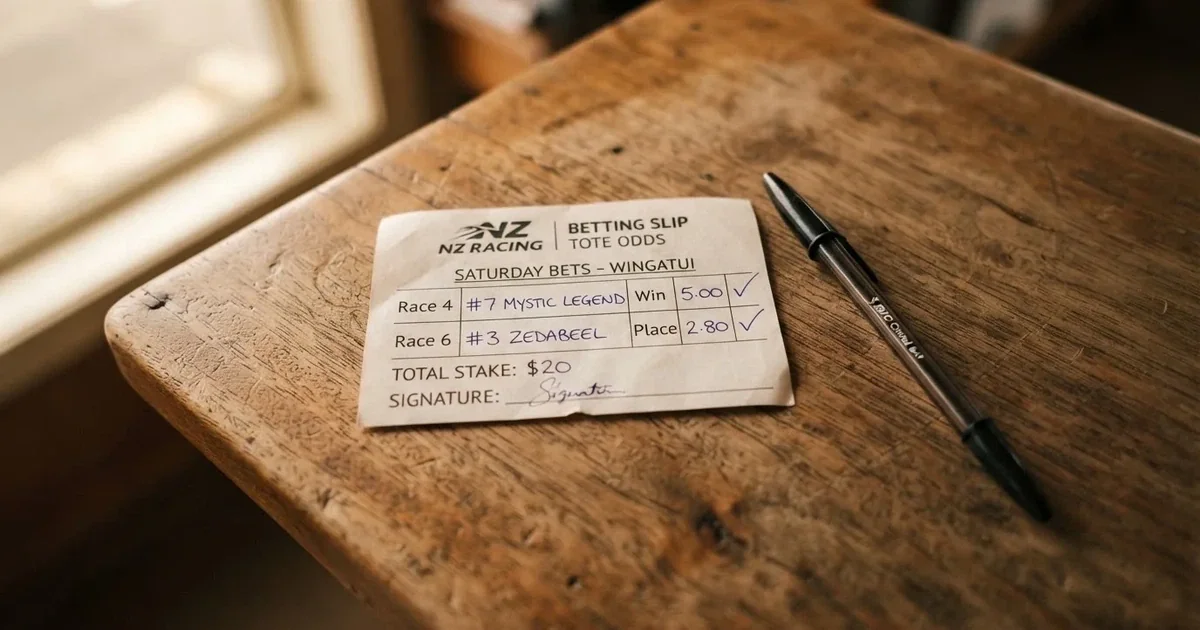
Best Bets for Today in New Zealand 2026: A Punter’s Reading Guide, Not a Tip Sheet
 Available in US
Data current as of 30 October 2026, checked against the Department of Internal Affairs (DIA) register of authorised providers under the Racing Industry Act 2020.

The search for “best bets for today in New Zealand” lands somewhere it might not. Punters ask for tips, predictions, a name to back before kick-off. What this page does instead is explain the machinery behind any tip that arrives — the margin the bookmaker takes, what a value bet is and why no tipster’s word can guarantee a result. The choice this page maps is narrower than the question implies: since an amendment to the Racing Industry Act 2020 took effect on 28 June 2025, TAB NZ and its online sister brand Betcha are the only operators allowed to take online sports and racing bets in New Zealand. Everything outside those two brands sits in a different legal category, and the comparison that follows reads from that starting point.
Table of Contents
- The Shortlist: How Today’s Market Is Assessed
- What “Best Bet” Actually Means — A Working Definition
- The Mechanics: How a Price Is Built
- Staking and Bankroll: What the Math Says, and What It Does Not
- Why No Tip Is Ever Certain — and What That Costs
- Safer Gambling in New Zealand: The Tools and the Limits
- Legality in New Zealand: What the Law Says, and What It Does Not
- The Offshore Question, Framed Honestly
- How to Read Today’s Markets — A Practical Sequence
- What the Page Does Not Offer
- A Closing Frame
- Frequently Asked Questions
The Shortlist: How Today’s Market Is Assessed
A shortlist of ten operators sits below. Eight of them are not licensed here — they appear because New Zealand players meet them, not because the law treats them as alternatives. The list follows the same criteria across both groups: licence status, market depth, live and pre-match coverage, safer-gambling tools, payment method and the clarity of the operator’s own terms. A “best” bookmaker for a punter who can only bet with TAB NZ is a very different question from “best” for someone shopping for a foreign site, and the table below splits that difference into columns rather than choosing a side.

The angle taken throughout this shortlist is choice — which paths exist, who each one suits, and what each one costs the punter in terms of consumer protection and regulatory recourse. Where TAB NZ offers a guarantee that a payout dispute can be taken to a New Zealand body, an offshore site offers the same wider book of markets but no local backstop. A punt of $5 on the All Blacks is a different decision under the two regimes, and the comparison aims to make that visible rather than argue one down.
| Brand | New Zealand status | What the operator’s own terms state on the key |
|---|---|---|
| TAB | TAB NZ brand | Racing and sports betting under section 74AAA; 18+ only; deposit limits, time-outs and self-exclusion in-app; trackside live streaming; payouts in NZD |
| Betcha | TAB NZ brand | Racing and sports betting under section 74AAA; 18+ only; Multi Builder and Same Game Multis; Bet Social and Playbook features; daily Toolbox of odds boosts |
| LegendPlay | Not licensed in New Zealand | Anjouan Gaming Authority licence; sportsbook covers football, tennis, basketball, ice hockey plus virtual sports |
| Glorion | Not licensed in New Zealand | No licence that applies in New Zealand; pre-match and live betting, virtual sports, esports and entertainment markets; 18+ |
| 22Bet | Not licensed in New Zealand | Curaçao licence 8048/JAZ; single, accumulator, system and chain bets; live betting with real-time odds and score updates |
| Alawin | Not licensed in New Zealand | No licence that applies in New Zealand; pre-match and live sports, virtual sports and esports across seven listed sports |
| Spinbara | Not licensed in New Zealand | No licence that applies in New Zealand; casino-led brand with sportsbook; one casino game unavailable in New Zealand |
| Millioner | Not licensed in New Zealand | No licence that applies in New Zealand; pre-match and live betting on seven listed sports, separate virtual sports section |
| Rooster | Not licensed in New Zealand | Tobique Gaming Commission licence No. 0000002 (Costa Rica holder); Live, Sports Promotions, Results, E-sports and Predictions sections |
| BigClash | Not licensed in New Zealand | Curaçao licence 8048/JAZ; pre-match and live sports across international and local leagues, virtual sports and esports |
TAB — The Only Lawful Provider for Racing and Sports
TAB is the retail-and-online face of TAB NZ, the body the Racing Industry Act 2010 established and the Racing Industry Amendment Act 2025 reaffirmed. Since 28 June 2025, section 74AAA of the Act has barred every other operator from offering racing or sports bets to a person in New Zealand — regardless of where that operator is incorporated. TAB runs the tote pool for thoroughbred, harness and (until 1 August 2026) greyhound racing, plus fixed-odds markets on domestic and international sport. The TAB NZ app carries a 17+ App Store age rating while stating that customers must be 18 or over to bet — a gap that reflects Apple’s store policy, not the law, and the 18-year threshold is the one that governs.

The product on offer is wide by domestic standards. Rugby union and rugby league, horse and harness racing, cricket, basketball, football, American football and tennis all appear in the app. Trackside live race streaming sits in-app with in-app betting, and racing form, Blackbook and Jockey Challenge tools are built in. A simplified wallet handles deposits and withdrawals. Safer-gambling controls — deposit limits, time-outs and self-exclusion — are listed in the app, and an exclusion set on TAB carries across both TAB NZ brands. For a punter who wants to back the All Blacks, the Warriors, the Black Caps or a local galloper and have a New Zealand body to complain to if something goes wrong, TAB is the only place that fits.
Betcha — The Same Operator, a Younger Brand
Betcha is the second online brand of TAB NZ — never a rival. The product skews younger and more social. A daily Toolbox offers odds boosts and insurance tools for bets that do not land. A Bet Social section lets punters chat, follow tipsters and share bets or pools. A Playbook holds tips and match analysis. The Multi Builder builds combination bets, copies trending multis and tracks live legs, and a multi-grid builds Same Game Multis from one event. The product is the same betting engine under a different skin, and the same 18+ rule and the same exclusion framework apply.
For a punter who finds the TAB app’s racing-first layout conservative, Betcha offers the same markets in a more app-native format — without changing who is taking the bet.
LegendPlay, Glorion and 22Bet — Offshore Brands With Wider Books but No Local Backstop
The next three brands are offshore bookmakers New Zealand players encounter. LegendPlay runs a sportsbook with Sports, Live Betting and Virtual Sports sections, covering football, tennis, basketball and ice hockey. Glorion offers pre-match and live betting, virtual sports, horse racing and esports, with markets grouped into popular, niche, indoor and outdoor sports, plus entertainment events such as award shows and elections — a novelty market a local product does not carry. 22Bet takes single bets, accumulators, systems and chains and offers live betting with real-time odds and score updates.
None of these brands holds a licence that gives any right to take bets from a person in New Zealand. The Anjouan, Curaçao or Tobige licences they name do not reach the New Zealand consumer. DIA warns that overseas operators may be in jurisdictions with minimal consumer safeguards, may not return unspent credits and may not pay out large wins. A punter using one of these sites has no New Zealand complaints route and no harm-minimisation framework that follows them. For a punter who wants a market New Zealand law does not allow — a political futures market, a novelty bet — this is the only path, and it is a path with fewer guardrails.
Alawin, Spinbara, Millioner, Rooster and BigClash — Wider Sport Lists, Same Legal Position
Alawin covers football, tennis, table tennis, basketball, ice hockey, American football and baseball, with Live Betting, Virtual Sports and esports. Millioner’s book runs on the same list with separate Live and Virtual Sports sections. Rooster shows a Live, Sports Promotions, Results, Schedule, E-sports and Predictions layout with odds in six formats. BigClash covers international and local leagues, virtual sports and esports on FPS and MOBA titles. Spinbara is a casino-led brand with one noted game unavailable in New Zealand — a restriction on a single product, not on the site’s other markets.
The legal position is identical across all five. They are not licensed in New Zealand, and a New Zealand harm-minimisation framework does not reach them. The choice among them is mostly about which bookmaker’s own layout and odds format a punter prefers — a narrower decision than it looks from the marketing pages, because every one of them operates under the same section 74AAA prohibition. None of them is “the safe choice” for a New Zealand-based punter, and none of them is “the unsafe choice” for a punter who has weighed what they give up.
What “Best Bet” Actually Means — A Working Definition
The word “best” in “best bet for today” does not mean “the bet most likely to win”. Every bet loses more often than it wins at the prices a bookmaker offers, and the gap between what a punter pays and what the outcomes are truly worth is the bookmaker’s margin. The “best” bet is the one whose price the punter believes is larger than the bet’s true probability of landing justifies — a value bet.
A simple example makes the mechanic concrete. A bookmaker quotes $2.10 for heads on a coin toss. The fair price for a 50–50 event at zero margin is $2.00. The punter’s edge is the gap. At $2.10, the bookmaker is offering more than fair — but the coin’s true odds have not changed, and over many bets at that price the punter still loses the margin baked into every other market on the page. The edge is real, but small, and it takes discipline to collect.
The discipline is the hard part. A value bet can lose. A long run of losing value bets at $2.10 on a 50–50 event is exactly what the math predicts when the edge is thin. The punter who chases losses by raising stakes, by abandoning the price screen or by switching markets is no longer betting value — they are betting mood. That is the line a staking plan is meant to hold, and the plan is the second piece of the kit.
The Mechanics: How a Price Is Built
The Bookmaker’s Margin and Why It Eats “Best Bets”
Every price on a sportsbook carries a margin — the slice of every dollar wagered the bookmaker keeps, regardless of who wins. For a two-way market at decimal odds of 1.90 on both sides, the calculation is straightforward: the payout share is the reciprocal of the sum of the implied probabilities, so 1 ÷ (1/1.90 + 1/1.90) = 1 ÷ 1.0526 ≈ 0.95, and the margin is 1 − 0.95 = 0.05, or roughly 5%. That is the slice the bookmaker keeps of every dollar bet on this market, before any payout is made.
The number is not large, but it compounds. At a 5% margin, a punter who places 100 bets of equal stake at average odds around 1.90 expects to be roughly 5% behind at the end of the run — a number that gets larger the more bets are placed and the smaller the edge on each one. A “best bet” at 1.90 is not a 50/50 shot; it is closer to a 47.5/47.5/5 proposition against the punter, before any knowledge about form or line-ups is added. A punter who does not beat that margin over a large number of bets loses to it. The margin is the reason “tips” alone do not produce long-run profit.
The margin moves with market shape. A two-way market at 1.90/1.90 carries roughly 5%. A three-way 1X2 market on football at 1.50/4.00/6.00 carries a larger margin because three outcomes sum to more implied probability. Bookmakers widen margins on niche markets and on in-play prices that move quickly, and they tighten them on mainstream pre-match football, NBA and NRL. A punter who wants the best odds shops the margin, not the headline price, and a 1.91 quote at a 3% margin is a better bet than a 1.95 quote at a 7% margin even though the second number looks larger.
Reading Form, Statistics and Line-Ups
The second input to a value bet is what the punter knows. Form — wins, losses, recent results — sets the prior. Statistics — shot counts, possession, expected goals, run rates, dismissal rates — refine it. Line-ups, when known, change the picture: a key player rested, an injury at the last minute, a debut that shifts the shape of the side. Weather and surface matter for outdoor codes. For racing, the draw, the going, the jockey booking and the horse’s sectionals at the track all feed in.
The mistake is to read one piece of evidence at full strength. A football team on a six-game winning streak playing away from home is not a 1.50 shot — the home side’s record, the travel, the injuries and the market’s own reading of the price all compete. The art is weighting inputs that move the needle and ignoring ones that do not. Statistics that correlate weakly with winning — total passes, possession percentage — are less useful than ones that correlate strongly — shots on target, expected goals, conversion rates under pressure.
The Market’s Own Odds as a Check
The bookmaker’s price is itself a piece of information. Sharp money — bets from professional syndicates — moves the line first, and a price that has shortened sharply in the hour before kick-off carries information the form guide does not. A punter who sees 1.80 shorten to 1.60 without an obvious reason is being told something by the market. The bookmaker is not a friend, but it is a price-setter with skin in the game, and a price that drifts against the public is often right.
The catch is that the market reflects what the market knows, which is not always the same as what is true. A price can move on the weight of money that is itself uninformed, and a short-priced favourite can be a trap when the public piles in. The punter’s job is to weigh their own read against the market’s read and act only when the two disagree in the punter’s favour.
Staking and Bankroll: What the Math Says, and What It Does Not
A staking plan is a rule that says how much of the bankroll goes on each bet. The simplest is flat staking — the same dollar amount on every selection, whatever the odds. Flat staking does not require an edge per bet, only an edge over many, and it is the discipline most punters abandon first. The punter who raises stakes after losses — the martingale instinct — turns a thin edge into a fast ruin, because the next bet’s stake is funded by the last bet’s loss and the variance does not shrink to match.
A proportional plan stakes a fixed percentage of the current bankroll on each bet. The dollar amount falls after losses and rises after wins, which keeps the punter in the game through a downswing and lets winners compound. The plan demands an edge and a large enough sample for the math to work; it punishes over-bettors who fire on every match and under-bettors who never stake enough to make the edge meaningful.
A unit-based plan — one unit per bet, two units on a strong gesture — sits between the two. The unit is a fixed fraction of the bankroll, say 1% or 2%, and the staking rule is simple to follow. The plan’s virtue is that it survives a bad week. A punter who bets 2% of bankroll per selection can lose eight bets in a row and still have 85% of the bankroll left to continue, and the long-run edge has room to play out.
What none of these plans does is promise a result. A staking plan is a discipline, not a system. A punter who follows it and has no edge still loses; a punter who has an edge but abandons the plan after a bad week loses too. The plan holds the punter together while the math does its slow work.
Why No Tip Is Ever Certain — and What That Costs
A tip is a claim. A claim is a statement about a future event that may or may not come true. The strongest claim a tipster can make is “this is my best read on the available information”, and that is the only claim worth reading. Anything stronger is either ignorance of how betting works or marketing for a tipster service that profits from subscriptions, not from winning bets.
The reason certainty is impossible is the reason the margin exists: outcomes are uncertain and prices reflect that uncertainty. A 1.50 favourite wins roughly two out of three times — not always, and not in any order the punter can predict. The third loss is the one that costs the most because it breaks the staking plan that worked on the first two wins. A punter who does not budget for that loss does not have a staking plan.
The frame that follows from this is one the page keeps at the centre: betting is no income. The punter who treats it as one — quitting a day job, raising stakes to chase rent, betting with money earmarked for bills — is the puntor for whom a loss is not a number on a screen. Safer-gambling tools exist for that punter. They are the next section.
Safer Gambling in New Zealand: The Tools and the Limits
The punter who needs a brake has several in New Zealand. TAB NZ’s app lists deposit limits — daily, weekly or monthly caps the punter sets and which the operator enforces. Time-outs close the account for a chosen window, from 24 hours to several weeks. Self-exclusion closes it for longer, from six months to five years, and an exclusion set on one TAB NZ brand carries across to the other. The free Gambling Helpline — 0800 654 655, or text 8006 — runs 24 hours and is the first stop for a punter who feels the brakes are not holding. Safer Gambling Aotearoa offers online tools and counselling.
The age for betting with TAB NZ is 18. The age rating on the App Store is 17+, a gap that reflects Apple’s policy rather than the law, and the 18-year threshold is the one that governs. Betting under 18 is an offence under section 89 of the Racing Industry Act 2020. Land-based casinos set the age at 20 — a different permit, a different rule, and never to be merged.
TAB NZ pays a Problem Gambling Levy of 0.74%, in force from 1 July 2025 to 30 June 2028. The levy funds treatment services and harm-minimisation research. Its presence is one reason TAB NZ’s product carries a local backstop that offshore brands do not — the levy is part of the harm-minimisation framework a New Zealand punter can reach. Offshore brands are outside the levy and outside the framework. A punter who uses one and needs help reaches for the same helpline, but the operator is not part of the system that funds it.
The greyhound code is closing in stages from 1 August 2026, and from that date offshore operators may not take bets on greyhound races either. The change is part of a wider rethink of gambling harm in New Zealand, and the Online Casino Gambling Act 2026 extends the framework to online casino gambling without touching the sports-betting monopoly. The two are separate permits with separate rules; a casino licence is never a betting licence.
Legality in New Zealand: What the Law Says, and What It Does Not
The Racing Industry Act 2020 establishes TAB NZ as the sole provider of racing and sports betting in New Zealand. The Racing Industry Amendment Act 2025 inserted section 74AAA, which took effect on 28 June 2025: no person other than TAB NZ may offer racing betting, sports betting or other racing or sports betting to a person in New Zealand, regardless of where that person is resident or incorporated. The Department of Internal Affairs is the regulator; it told unlicensed providers to withdraw with immediate effect. There is no licence register for bookmakers, because there is only one lawful operator, and there is no route to apply for one.
The law targets the operator. Section 19(4) of the Gambling Act 2003, inserted in 2025, says an individual may not be convicted for placing a bet with an offshore operator in breach of section 74AAA — no published penalty for a player was found. New Zealand does not geo-block offshore sites; it puts liability on the operator that serves the New Zealand punter. The penalty for an operator that breaches section 74AAA is not stated in the section, and no prosecution of an offshore bookmaker was found.
TAB NZ’s commercial partner is Entain NZ. A 25-year agreement signed in 2023 gives Entain a 50/50 share of gross profits, with at least $150m a year going to TAB NZ for the first five years. Entain pledged a one-off $100m payment to the racing sector. The partnership runs the TAB business day-to-day; the licence sits with TAB New Zealand, the statutory body.
The Online Casino Gambling Act 2026 licenses online casino gambling only. TAB New Zealand winning the right to apply for a casino licence does not extend the betting monopoly, and a casino permit is not a betting permit. The point-of-consumption charge on offshore racing and sports bets ceased on 30 June 2026 — a tax that has been removed, not a licence that has been granted. A tax being payable never made an offer lawful; the cessation does not make an offer lawful either.
For the player, Inland Revenue guidance says recreational gambling winnings are generally not taxable and prize money from TAB horse, dog and trotting races is not taxable. A person who bets as a business is a different case — general information, not tax advice. The page notes the rule without giving tax advice.
Advertising follows the Advertising Standards Authority’s Gambling Advertising Code. Ads must not target children (under 14) or young people (14 to under 18), judged by context, appeal and expected audience, must not encourage harm, and must be truthful with terms available. No New Zealand equivalent of a “whistle-to-whistle” ban for betting was found. TAB NZ runs “bonus bets” promotions; no New Zealand rule on bet-bonus size or wagering terms was found, so what the page says about TAB NZ offers comes from TAB NZ’s own terms, not from a statutory limit.
The Offshore Question, Framed Honestly
The honest framing is this. TAB NZ and Betcha are the only lawful options, with New Zealand harm-minimisation tools, regulator oversight and a complaints framework. Offshore brands are unlawful for the operator to serve New Zealand, with no New Zealand complaints route, with DIA’s stated risks, and with limits possible elsewhere that TAB NZ’s terms do not carry.
Neither is “the safe choice” by default. A punter who chooses TAB NZ gives up the wider book of markets and the novelty bets that offshore brands offer — political futures, award-show markets, esports skins markets — and accepts a smaller product. A punter who chooses an offshore brand accepts a wider book and gives up the local backstop. The choice is not between safe and unsafe; it is between a smaller book with a local framework and a wider book with a foreign one. The page describes both and judges neither.
What DIA warns about offshore brands is the practical content of that judgment. An overseas operator may be in a jurisdiction with minimal consumer safeguards. It may not return unspent credits. It may not pay out large wins. The complaints route is the operator’s own licence holder — Tobique, Anjouan, Curaçao — and the route is slow, in a foreign language, and outside the levy-funded harm-minimisation framework. A punter who accepts those trade-offs is making a choice, not breaking a rule.
How to Read Today’s Markets — A Practical Sequence
A punter who opens the TAB NZ app or the Betcha app on race day or match day sees a wall of markets. The order to read them is the same across both. First, identify the event and the market — the All Blacks vs. one specific match, a win market on a specific race. Second, check the price against the punter’s own estimate of true probability. A 1.80 quote on a 50–50 event is below par; a 2.20 quote is above. Third, check the market margin by adding the implied probabilities across the outcomes — a sum of 1.05 means a 5% margin, a sum of 1.08 means 8%. Fourth, decide the stake against the bankroll rule — flat, 2% of bank, or a unit system — and place it.
The order is the same on an offshore brand. The difference is that the local backstop is missing and the safer-gambling tools are the operator’s own terms, not the New Zealand framework. The punter who reads a market well and reads a bookmaker’s terms carefully gains nothing from the offshore brand that the local one does not offer, except markets the local one does not carry. The punter who reads markets badly gains nothing at all, and the wider book only widens the surface area for the bad read.
What the Page Does Not Offer
The page does not offer picks, predicted results, or odds for specific matches. No model in this article names a winner. The reason is the one at the centre of the page: betting is no income, and no tip — from any source — can change the math that makes a 1.90/1.90 market a 5% margin against the punter. A punter who acts on a predicted winner on this page’s word loses real money on a claim this page will not make.
The page does not advertise operators. The offshore brands listed above are reviewed because New Zealand players meet them and need to know what each one offers and where each one stands legally. The review is not a recommendation to sign up. The TAB NZ brands are reviewed because they are the only lawful options; the review is not an endorsement beyond the fact of their lawful status.
The page does not list bonus codes, promo codes or sign-up links. The offers on TAB NZ and Betcha are described by what they are and what their terms say, not by how they are activated. A promo code is plumbing between the punter and the operator; the page describes what an offer is worth, not how to claim it.
A Closing Frame
The honest summary fits in a sentence. TAB NZ and Betcha are the only lawful books in New Zealand since 28 June 2025, the margin on every market is the slice a bookmaker keeps before any payout is made, a value bet is the one whose price exceeds the bet’s true probability and a staking plan is the discipline that lets the long-run math do its work. Everything else on the page is in service of those four claims. No tip survives the claim. No bookmaker survives the claim either. The punter who reads them both survives the math.
Frequently Asked Questions
What bets might I take today?
The question assumes there is a list. There is not. The honest answer is that a bet is worth taking when the price offered exceeds your own estimate of the bet’s true probability, the market’s margin is small enough to leave room for an edge, and the stake fits a bankroll plan you can hold through a losing week. Any bet that fails those three tests is not worth taking, regardless of which team or horse is on the slip.
What is a value bet, and why is no tip ever certain?
A value bet is a wager whose decimal odds are higher than the bet’s true probability of landing justifies — a 2.10 price on a 50–50 event, for example. No tip is ever certain because the bookmaker’s margin is built into every price, and outcomes are uncertain by definition. A long run of value bets produces a slow profit; a long run of tips alone produces whatever the tipsters got right by chance. The two are not the same activity.
What is the bookmaker’s margin, and how can it be seen in the odds?
The margin is the slice of every dollar wagered the bookmaker keeps, regardless of who wins. For a two-way market at 1.90 on both sides, the implied probabilities sum to roughly 1.053, which gives a payout share of about 95% and a margin of about 5%. The wider the sum across outcomes, the larger the margin. The punter who shops margins over headline prices finds the better bets.
How is the return on a bet worked out from the stake and the odds?
For a single bet, the return is the stake multiplied by the decimal odds — a $10 stake at $2.10 pays $21 total, of which $11 is net profit. For a multi bet, the odds of the legs multiply into one price before the stake is applied — three legs at $2.00, $3.00 and $4.00 give a combined price of $24, and a $10 stake returns $240 total. The stake is paid back with a win on a single; on most multi promotions the stake is paid back too, but on a free bet the stake is not, and the value of the free bet is what the formula in this article does not cover separately.
Which bookmaker may lawfully take sports and racing bets in New Zealand?
TAB NZ, through its two online brands TAB and Betcha, under section 74AAA of the Racing Industry Act 2020, in force since 28 June 2025. The Department of Internal Affairs is the regulator. There is no licence register for bookmakers, because there is only one lawful operator, and no licence to apply for. Offshore brands are not lawful options for a New Zealand punter; the law targets the operator that serves the punter, and the page does not invite a reader to sign up with one.
Prepared by the Kiwimobilebetting editorial staff.