How to bet on sports in New Zealand in 2026: the betting monopoly, the maths, and what an offer really costs
 Available in US
The data in this guide was checked as of 30 October 2026 against the New Zealand Department of Internal Affairs register of approved operators and the Racing Industry Act 2020 as amended in 2025. Thea Sands, betting editor.

Since an amendment to the Racing Industry Act 2020 took effect on 28 June 2025, TAB NZ and its online sister brand Betcha are the only operators allowed to take online sports and racing bets in New Zealand, and the Department of Internal Affairs told unlicensed providers to withdraw with immediate effect. That is the single fact the rest of this page sits on, and most of the cost stories the rest of this page tells come from it.
The page below covers the bet types a New Zealand punter actually meets, the sports the only lawful bookmaker prices up, the procedure for placing a bet from a phone, the comparison set a New Zealand reader will encounter, the legal frame around it, the safer-gambling tools that exist here, and the ten brands a comparison has to name. Throughout, the angle is cost: what each offer and each market actually pays back, what it charges the bettor, and where the difference is hidden in the maths.
Table of Contents
- Reading odds before anything else
- Bet types a New Zealand punter will meet
- Sports, codes and tournaments on the TAB NZ programme
- Placing a bet from a phone: the working sequence
- The bookmaker’s margin, and what the odds actually cost
- What a free bet is actually worth
- A shortlist for New Zealand bettors
- The lawful two: TAB and Betcha
- The unlicensed eight: what the brand list actually costs a New Zealand punter
- Operator write-ups
- The law that closes the rest of the market
- Responsible gambling in New Zealand
- Where the rest of the cost stories live
- Frequently asked questions
Reading odds before anything else
Decimal odds are the New Zealand convention. A price of 2.10 means a winning $10 stake returns $21 — the original $10 back, plus $11 of profit. The shorter the price, the more the bookmaker thinks the runner will win; the longer the price, the less it thinks so. The distance between what the bookmaker thinks and what its price implies is the margin, and the margin is what the page will keep coming back to, because it is the part the bettor pays on every bet, win or lose.

A single wager on the All Blacks at 1.45 to beat France is a confident punt at a short price. A multi on All Blacks to win, the Black Caps to clear their total, and the Warriors to cover a 6.5-point line is a different thing: the three legs multiply, the price grows, but every leg has to land, and the chance of all three landing is the product of the chances, not the sum. That is where the cost shows up. A $5 multi at 8.50 pays $42.50 if it wins and pays nothing if any leg fails.
Two prices worth committing to memory, because the page will use them later: 1.90 and 1.90, the example pair this page uses to show what a market margin looks like. They are illustrative, not quoted.
Bet types a New Zealand punter will meet
The full catalogue in the TAB NZ betting rules is wider than a new punter will ever use, and most of it is racing terminology, because tote betting is part of TAB NZ’s job. The list that follows is the working set, the bet types a phone-led punter on rugby, football, basketball, cricket, NFL and the racing codes will actually click.

Single bets and the simple maths
A single bet is one stake on one outcome at one price. A $20 single on the All Blacks at 1.55 returns $31 if the All Blacks win, and returns nothing if they do not. There is no clever structure to the cost: the punter pays the margin built into the price, the punter pays nothing on top, and the bet settles one way or the other.
This is the cleanest bet the bookmaker offers, and the cleanest bet the punter can place. Any cost story that follows elsewhere on the page assumes the bet is a single unless the page says otherwise.
Win, place and each way on the racing codes
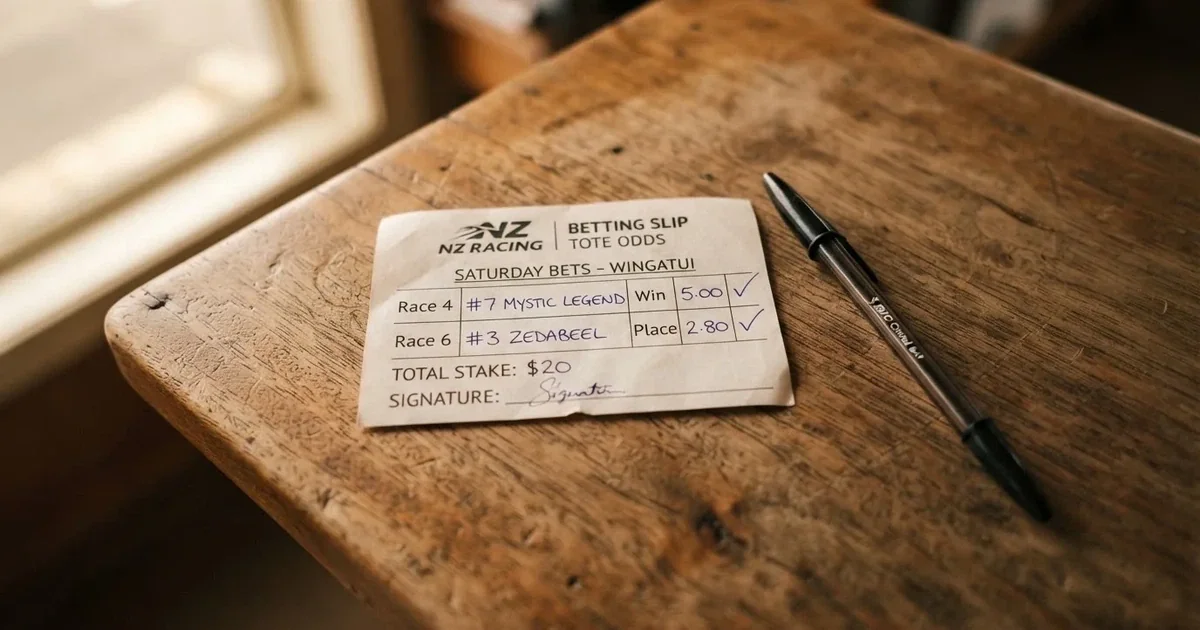
The racing bet types are where New Zealand’s vocabulary gets its own colour. A Win bet pays out if the runner finishes first. A Place bet pays out if the runner finishes in the place positions, which vary by field size — typically first, second and third in a field of eight or more. An Each Way bet is two bets of equal stake: one on Win, one on Place, and the stake doubles. A $10 Each Way at $6 for a horse in a 12-horse field costs $20 to place, returns $60 if the horse wins (Win $50 + Place dividend) and returns less if the horse only places.
A Quinella picks the first two runners in any order, an Exacta picks the first two runners in order, a Trifecta picks the first three in order, and a First Four picks the first four in order. Each step up adds combinations the punter has to fund. A Quaddie asks the punter to pick the winner of four nominated races, usually the last four on a meeting, and the pool is shared by everyone who picks all four. A Big6 is a six-leg version of the same idea. The dividend on these pool bets is not known when the bet is placed: it is the pool divided by the number of winning units, less the operator’s take.
The cost point that matters: a $1 Trifecta on a 12-horse field costs the punter $1320 across the full field of combinations if they decide to “box” every runner. Boxing is a popular structure for first-time players and a popular source of large, silent losses.
Multi bets, same-game multis and the leg-by-leg cost
A multi is a single bet on two or more legs that pays only if every leg wins. Two legs at 2.00 and 2.00 become 4.00 as a multi. Three legs of 1.50 each become 3.375. The price grows multiplicatively; the implied probability of the multi winning shrinks in the same proportion. A $5 multi at 12.00 pays $60 if all three legs win and pays nothing if any one of them fails.
A Same Game Multi (SGM) is a multi whose legs come from one event: a rugby match that pays out on the All Blacks to win, by 1-12 points, with both teams scoring. The legs look related, but the correlation is not a free gift — the bookmaker’s pricing already accounts for the fact that a 1-12 point All Blacks win is more likely when both teams score. The cost of an SGM is what its price says it is, not what its legs look like.
SGMs are the most aggressively marketed bet on the phone app, with the most prominent “Boosted” tags. The boost adds a few cents to the price; the underlying leg cost is the same as a single. The punter’s edge against a boost is a marketing margin on top of a bookmaker margin.
Over/under, line and handicap bets
An over/under (or total) bet asks whether the combined score will be over or under a number the bookmaker sets: will the All Blacks and France score more or fewer than 47.5 points combined. A handicap (or line) bet asks whether a side will cover a spread: the All Blacks at -6.5 must win by 7 or more. These are the workhorse markets for football, basketball, the NFL and the NRL, and the prices around them are where the margin usually sits, because the public gravitates to the favourites and the bookmaker skews the line.
A small favourite at -3.5 at 1.90 is a different proposition to that same favourite at -3.5 at 1.85. The five-cent difference in price is the difference between a 5.13% margin and a 5.41% margin, by the page’s own arithmetic later. The bettor pays the margin on the price, not on the favourite.
Futures, outrights and season-long bets
An outright or futures bet is a wager on the outcome of a competition, not a single match: the All Blacks to win the Rugby World Cup, the Warriors to make the NRL top eight, the Melbourne Cup winner named in October. The price is long because the field is wide, the bet sits open for months, and TAB NZ’s terms say outright bets are typically settled when the official result is confirmed.
The cost on a futures bet is the same as any single, but the time the stake is locked up is months, not hours. A $20 outright at 26.00 for a horse to win the Melbourne Cup pays $520 if the horse wins, and the stake is out of the punter’s pocket for half a year on average.
Cash-out and the lock-in problem
A cash-out feature settles a multi before the last leg has run, at a price the bookmaker sets. The price is lower than the full multi offers, because the bookmaker is buying certainty on the open leg. A multi set to pay $250 if it lands will cash out for $120 with one leg to run if the open leg is an underdog that the price no longer favours.
Cash-out is a feature, not a gift. The cost of the certainty is the difference between the cash-out number and the full payout; the punter who cashes out a winning multi before the last leg has paid for the privilege of not waiting to find out.
Sports, codes and tournaments on the TAB NZ programme
TAB NZ prices up the racing codes and the major sports. The set is not the deepest globally, and the depth varies by season, but the working catalogue for a phone punter in 2026 runs to the codes below.
Rugby union and rugby league
Rugby is the headline sport for the New Zealand market, both codes. The All Blacks play test matches year-round; Super Rugby Pacific runs from late February to late June; the NPC fills the New Zealand winter; the Rugby World Cup sits on a four-year cycle. TAB NZ carries fixed-odds win, line and total markets on All Blacks tests, multi-leg SGMs, and outright prices for the World Cup and Super Rugby Pacific well in advance.
NRL is the league code most New Zealanders follow, with the Warriors the local anchor. TAB NZ prices up NRL matches weekly, with full head-to-head, line and total markets, plus a season outright and a top-eight market. State of Origin and the NRL Grand Final are the highest-volume betting days on the rugby league programme.
Football, the A-League and overseas leagues
The domestic A-League and the Wellington Phoenix are the home fixtures, and the English Premier League, La Liga, Serie A, the Bundesliga, Ligue 1 and the UEFA Champions League are the year-round programmes most New Zealand punters follow. TAB NZ carries 1X2, double chance, both teams to score, correct score, half-time/full-time and over/under markets on the major leagues, with live betting on selected matches.
The depth falls off quickly for leagues outside the top five European competitions. A punter looking for a full Eredivisie card, a full Belgian Pro League card or a full J-League card will find fewer markets and a wider margin in the markets that do exist.
Cricket, the Black Caps and the IPL
The Black Caps play tests, ODIs and T20 internationals year-round; the domestic Plunket Shield and Super Smash carry shorter markets; the Indian Premier League and the Big Bash League run in the New Zealand summer, with the Hundred in the UK winter. TAB NZ carries match, series and outright markets, with over/under and player-performance markets on the headline events.
The margin on the IPL and the Big Bash is wider than the margin on a Black Caps test, because the price is set by a smaller book with fewer sharp accounts weighing in.
Basketball, the NBA and the Breakers
The NBA is the year-round basketball programme, with the playoffs and Finals running from April to June. The New Zealand Breakers play in the Australian NBL, with a season that overlaps the NBA’s. TAB NZ carries the standard head-to-head, line and total markets on the NBA slate, with a season outright and conference outright available before tip-off.
The NFL and the Super Bowl
The NFL season runs from September to early February, with the Super Bowl the highest-volume single betting day on the New Zealand calendar. TAB NZ carries the full slate of week-by-week markets, with futures, division winners and the Super Bowl outright priced up from week one.
Horse racing, harness and greyhounds
Racing is the original TAB NZ product, and the racing programme is the deepest in the catalogue. Thoroughbred, harness and greyhound meetings run daily across New Zealand and Australia, with the Melbourne Cup, the Karaka Million and the New Zealand Derby the headline events. TAB NZ takes win, place, each way, quinella, exacta, trifecta, first four, daily double, running double, quaddie and Big6 bets on every meeting, plus multis that span meetings and same-race multis.
Greyhound racing in New Zealand is closing in stages from 1 August 2026, and from that date offshore operators may not take bets on New Zealand greyhound races either. The thoroughbred and harness programmes are unaffected.
Tennis, golf, combat sports, motorsport and the rest
TAB NZ carries outright markets on the four tennis Grand Slams and weekly markets on the ATP and WTA tours, with depth falling off outside the Slams and Masters 1000s. Golf carries outright markets on the four majors and the PGA Tour’s signature events, plus weekly tournament markets. Combat sports: boxing and MMA/UFC carry the standard markets, with the headline pay-per-view events carrying the deepest cards.
Motorsport carries Formula 1, Supercars and MotoGP outright and race markets, with NASCAR available for the Daytona 500 and the championship. Cycling carries the Tour de France outright and stage markets, with the Giro and the Vuelta priced up alongside.
Esports and the open question
The Racing Industry Act 2020 does not say whether an esports bet is a sports bet. TAB NZ prices up selected esports events on its programme, mostly CS2, League of Legends, Dota 2 and Valorant. The legal classification has not been tested, and the page does not pretend it has. A punter who wants to bet on esports from New Zealand is using TAB NZ, with the caveat that the legal category of the bet is not settled.
Placing a bet from a phone: the working sequence
The procedure below describes a bet on the TAB NZ app or the Betcha app, because those are the two apps a New Zealand punter can lawfully use. The third-party brands the page names later in the comparison will each have their own flow, but the working shape is the same across the licensed market.
Download and identity
The TAB app is on the New Zealand App Store under the seller name New Zealand Racing Board. The Betcha app is on the same store, published by Entain New Zealand Limited and first released on 6 August 2024. Both apps carry a 17+ age rating and state that customers must be 18 or over to bet; the 18+ rule sits in section 89 of the Racing Industry Act 2020, and betting under 18 is an offence.
Account opening at TAB NZ requires a verified New Zealand address and verified ID. A punter with an overseas passport and a New Zealand visa can open an account, but the address check is real and the page does not pretend it is not. A punter whose only address is overseas cannot open an account.
Funding the account
TAB NZ takes deposits by debit card, by bank transfer and by the operator’s own prepaid methods. The minimum deposit and the maximum deposit are operator-level terms and live in the app’s wallet page. The account carries a single wallet that holds the punter’s stake money and the punter’s winnings, and the punter can withdraw back to the same source by the same method.
Crypto is not on the TAB NZ funding list. The page does not generalise a rule on crypto use from this absence: nothing in the law says a New Zealand punter may not hold crypto, and nothing in the law says a New Zealand punter may not move money through an offshore brand, but TAB NZ’s funding page is its own page, and the page writes only what the inputs carry.
Picking a market and placing the bet
A punter picks a sport from the menu, picks a competition, picks a match, and sees the head-to-head, line and total markets the bookmaker has priced. The punter taps a price, the bet lands on the slip, the punter enters a stake, and the slip shows the potential return. Confirm, and the bet is on. Live betting follows the same flow with prices that update between confirmations.
The slip is the only place the punter sees the price locked. A multi on the slip has the combined price displayed before confirm; a same-game multi has the combined price and the legs listed; a cash-out value appears on settled and partially-settled multis. The punter who reads the slip before tapping confirm is the punter who knows the cost of the bet.
Settling and withdrawing
TAB NZ settles racing bets on the official result; settles sports bets on the result at the end of play, with extras and totals settled on the official result; settles outrights on the official result. A bet that is voided by the rules (a match abandoned before completion, a player who does not start) returns the stake rather than paying out.
Withdrawals go back to the funding source by default, and the wallet shows the pending withdrawal. The minimum withdrawal and the processing time are operator terms and live in the wallet; the page does not pin a number that research does not carry.
The bookmaker’s margin, and what the odds actually cost
A bookmaker’s margin is the slice of every dollar bet that the bookmaker expects to keep. The price on every outcome of a market is set so that, if the bookmaker’s view of the probabilities is right, the bookmaker pays out less than a dollar for every dollar bet. The difference is the margin.
For a two-way market at decimal odds of 1.90 on each outcome, the arithmetic is short. The implied probability of 1.90 is 1 divided by 1.90, or 0.5263. Two outcomes at 0.5263 each sum to 1.0526. The bookmaker pays out 1 dollar for every 1.0526 dollars bet, keeps 0.0526 of every dollar, and the margin is 5.26%.
The page has stated the band the inputs allow, and the band is the right way to put it: at 1.90 and 1.90, a two-way market carries a margin of about 5.1% to 5.4% depending on rounding. At 1.85 and 1.85 the margin is roughly 8.1%; at 1.95 and 1.95 the margin is roughly 2.6%. The cleaner the market, the tighter the margin, and the more the punter keeps on a winning bet.
A three-way market — 1X2 on football, with home win, draw and away win — runs at a higher margin than a two-way market, because the draw is an outcome that is hard to price and bookmakers add a wider cushion. Margins on football 1X2 at top-tier matches typically run 6% to 8% on a tight book and wider than 10% on a thin book.
The cost of a margin shows up over volume, not on a single bet. A punter who places one $20 bet at 5% margin has paid $1 of expected value. A punter who places fifty $20 bets at 5% margin has paid $50. The single-bet story and the volume-bet story are different stories, and the volume story is the one the punter’s wallet knows.
What a free bet is actually worth
A free bet is a stake the bookmaker gives the punter rather than a stake the punter funds. A “bonus bet” of $10 on a multi that wins at 6.00 pays $60 if it lands, and the $10 stake is not returned. The bookmaker is paying out the profit, not the stake, and the bookmaker is doing so because the bookmaker’s marketing has decided the cost of the punt is worth the deposit that comes with it.
The expected value of a free bet is the value of the payout the bookmaker does pay, weighted by the chance the bet lands, and discounted by the margin of the market. At a price of 3.00 on a market with a 5% margin, a $10 free bet returns $20 on a win, and the expected value is $20 multiplied by the chance of winning at 3.00, multiplied by 0.95 for the margin. That is the cost the punter can read into the offer, and it is the number the offer is worth on average.
A “risk-free” bet that is refunded as a bonus bet is a different offer. The refund is paid in bonus-bet money, the stake of the refund is not paid back if the second bet wins, and the punter has to clear the refund through the betting turnover before withdrawing. The cost of the “risk-free” name is the cost of a stake the punter does not get back if the bet wins.
A “deposit match” of 100% up to $200 is a different offer again. The punter deposits $200, the bookmaker adds $200 in bonus money, and the bonus money has to be turned over a number of times at a minimum price before it is paid out as cash. The punter’s edge is the value of the bonus less the expected cost of the turnover, and the expected cost is the turnover multiplied by the margin of the market the turnover has to be placed in. A $200 bonus with a 5x wagering requirement at a 5% margin costs an expected $50 in margin over the life of the bonus, on a $200 bonus. The net expected value to the punter is the bonus value less the $50, and the page writes that as $150 worth of expected value, not “free $200”.
The same logic reads backwards into a “boosted odds” tag. A boosted price from 2.00 to 2.10 is a 5% lift on the price, which is roughly 2.5 cents of value per dollar staked. The punter’s edge against a 5% market margin on the same selection is small, and the boost is marketing more than it is a free lunch.
A shortlist for New Zealand bettors
The page carries ten brands. Two of them — TAB and Betcha — are the only two a New Zealand punter can lawfully use, and they are the same operator, not two bookmakers competing. The other eight are brands a New Zealand punter will meet on a comparison site, and each is not licensed in New Zealand, with the costs that come with that. The page describes the ten on the same criteria; the page does not pretend the eight are options the punter can take.
| Brand | New Zealand status | What the operator’s own terms say on the key’s subject |
|---|---|---|
| TAB | The licensed online brand of TAB NZ, the only operator allowed to take sports and racing bets from people in New Zealand under the Racing Industry Act 2020 as amended | Takes fixed-odds and tote bets, carries safer-gambling tools in-app (deposit limits, time-outs, self-exclusion) and lists the Gambling Helpline (0800 654 655) and text line 8006; takes bets on racing codes, rugby union and league, football, cricket, basketball, NFL, tennis, golf, motorsport and combat sports; 18+ to bet; Trackside live race streaming in-app |
| Betcha | The second licensed online brand of TAB NZ, run by Entain NZ under the 2023 partnership, and not a separate bookmaker | Covers horse, greyhound and harness racing plus rugby, NRL, MMA/UFC, NBA, NFL, tennis, cricket, football, motorsports and esports; 18+ to bet; first released on the NZ App Store on 6 August 2024 |
| Thunderpick | Not licensed in New Zealand; Curaçao licence (OGL/2024/677/0722) gives no right to take bets from people in New Zealand | Esports-first bookmaker covering CS2, League of Legends, Dota 2 and Valorant, with a sportsbook offering cash-out and markets from the Champions League to the NFL |
| BigClash | Not licensed in New Zealand; Curaçao licence (8048/JAZ) gives no right to take bets from people in New Zealand | Pre-match and live sports betting across international and local leagues, plus virtual sports and esports on FPS and MOBA titles |
| Telbet | Not licensed in New Zealand; no licence that applies in New Zealand | Crypto casino and sportsbook with in-play betting, a My Bets page, separate sports betting rules, bonus terms, and responsible gambling and AML policies |
| RTbet | Not licensed in New Zealand; Curaçao licence gives no right to take bets from people in New Zealand | Sportsbook covering football, tennis, table tennis, basketball, ice hockey, American football and baseball, with live betting and virtual sports |
| 22Bet | Not licensed in New Zealand; Curaçao licence (8048/JAZ) gives no right to take bets from people in New Zealand | Over 30 market types per event, including 1X2, Double Chance, totals, both teams to score, correct score and HT-FT, plus tennis game, set and handicap markets |
| Roobet | Not licensed in New Zealand; Curaçao licence (OGL/2024/687/0427) gives no right to take bets from people in New Zealand | Sportsbook covering soccer, basketball, tennis, Counter-Strike, FIFA, baseball, ice hockey, MMA and table tennis; 18+ to play |
| Spinbara | Not licensed in New Zealand; no licence that applies in New Zealand | First deposit bonus of 100% up to EUR 100 and a sport crypto welcome of 100% up to 200 USDT, alongside a casino welcome of 100% up to EUR 500 plus 200 free spins |
| Alawin | Not licensed in New Zealand; no licence that applies in New Zealand | Sportsbook covering football, tennis, table tennis, basketball, ice hockey, American football and baseball, with Live Betting, Virtual Sports and esports |
The columns the table does not carry are the columns the inputs do not back. The page does not fill them with em dashes; the table carries the gap as the gap.
The lawful two: TAB and Betcha
The two lawful brands are the same operator, and the page does not call them rivals. TAB is the older brand, with a programme that runs from the racing codes to the major team sports and an app that has been on the New Zealand App Store since 8 September 2014. Betcha is the newer mobile-first brand, published by Entain New Zealand Limited, with a programme that mirrors TAB’s catalogue and an app released on 6 August 2024. Both run off the TAB NZ wallet, both honour the same safer-gambling tools, and both pay out through the same TAB NZ framework.
TAB NZ’s partner Entain runs the TAB business under a 25-year agreement signed in 2023 that gives Entain a 50/50 share of gross profits, with at least $150m a year going to TAB NZ for the first five years, and Entain pledged a one-off $100m payment to the racing sector. The partnership is the reason Betcha exists as a separate app under the same lawful umbrella, and the reason the two apps share a wallet and a self-exclusion register.
The right way to think about the choice between TAB and Betcha is the app a punter will use. TAB is the full-feature bookmaker, with the deepest programme, the racing products, Trackside live race streaming with in-app betting, racing form, Blackbook and Jockey Challenge tools, and a wallet for deposits and withdrawals. Betcha is the mobile-first sister, with the same programme pared back for a phone screen and the same wallet underneath. A punter who bets on horse and harness racing with any regularity is using TAB, because the racing products live there. A punter who bets on team sports only and wants a phone-first product is using Betcha, because the team-sports navigation is faster. Either is the lawful choice, and a punter who self-excludes through one excludes through both.
The unlicensed eight: what the brand list actually costs a New Zealand punter
The remaining eight brands on the table are brands a New Zealand punter meets on a comparison site or in a marketing email. Each is not licensed in New Zealand, each names a Curaçao licence (where a licence is named at all), and the Curaçao licence gives the brand no right to take bets from people in New Zealand. The page describes each on the same criteria the licensed two are described on, and the page does not pretend the unlicensed eight are options a New Zealand punter can take.
The cost story is the same on all eight, and the cost story is structural rather than a per-brand story. A New Zealand punter using an unlicensed brand has no New Zealand regulator to complain to if the brand refuses a withdrawal; no New Zealand harm-minimisation framework reaches the account; the brand is not obliged to honour the deposit limits, time-outs and self-exclusion that TAB NZ runs; the brand’s safer-gambling page is its own page, written for a global market, and the page does not include the Gambling Helpline (0800 654 655) or the text line 8006 that TAB NZ lists. The Department of Internal Affairs warns that overseas operators may be in jurisdictions with minimal consumer safeguards, may not return unspent credits and may not pay out large wins.
The first cost the punter pays is the legal one. The Racing Industry Amendment Act 2025 inserted section 74AAA: no person other than TAB NZ may offer racing betting, sports betting or other racing or sports betting to a person in New Zealand, regardless of where that person is resident or incorporated. The law targets the operator, not the player. Section 19(4) of the Gambling Act 2003 (inserted in 2025) says an individual may not be convicted for placing a bet with an offshore betting operator in breach of section 74AAA, and no source states a penalty for a player. The cost of the law is a closure of the legal options rather than a fine on the punter, and the page writes the closure rather than the fine.
The second cost is the operational one. A New Zealand punter with an account at an offshore brand has no recourse to the Department of Internal Affairs, no recourse to the Gambling Commission, and no recourse to the New Zealand courts if the brand refuses a withdrawal, voided a winning bet on a technicality, or closed the account. The recourse is the brand’s own complaints process, and the brand’s own complaints process ends in the brand’s own ruling. The page writes this as a structural fact rather than a per-brand risk, because the structural fact is what holds across all eight.
The third cost is the harm-minimisation one. A punter with a TAB NZ self-exclusion has excluded across both TAB and Betcha, and the exclusion is enforced at the operator level. A punter with an offshore account has to exclude at each offshore brand, and the exclusion depends on each brand honouring the request. The punter who is trying to stop is using a thinner tool than the punter who has the registered tool, and the registered tool is the one that travels across the lawful brands.
Thunderpick, BigClash, Telbet, RTbet
These four are the esports-heavy and crypto-heavy end of the unlicensed list. Thunderpick is esports-first, with CS2, League of Legends, Dota 2 and Valorant on the front of the programme and a sportsbook carrying a cash-out feature and markets from the Champions League to the NFL. BigClash is the multi-vertical operator, with pre-match and live sports across international and local leagues, virtual sports, and esports on FPS and MOBA titles. Telbet is a crypto casino and sportsbook, with a published welcome offer on the Russian-language site and an English site that runs in-play betting, a My Bets page, and separate sports-betting rules, bonus terms, and responsible-gambling and AML policies. RTbet is the football-heavy end, with football, tennis, table tennis, basketball, ice hockey, American football and baseball, plus live betting and virtual sports.
For a New Zealand punter, the offering is the offering a global crypto and esports bookmaker runs, and the offering is not lawful to take from a New Zealand address. A punter who already holds an account at one of these brands for casino play is not in a different position on the sportsbook side, and the page does not pretend the casino account is the path in.
22Bet, Roobet, Spinbara, Alawin
These four are the casino-heavy end of the unlicensed list, and each carries a sportsbook that is the casino’s secondary product. 22Bet is the deepest of the four on markets, with over 30 market types per event, including 1X2, Double Chance, totals, both teams to score, correct score and HT-FT, plus tennis game, set and handicap markets. Roobet is the crypto casino, with a sportsbook covering soccer, basketball, tennis, Counter-Strike, FIFA, baseball, ice hockey, MMA and table tennis. Spinbara is the bonus-heavy end, with a first-deposit offer of 100% up to EUR 100, a sport-crypto welcome of 100% up to 200 USDT, and a casino welcome of 100% up to EUR 500 plus 200 free spins. Alawin is the multi-vertical operator, with the same sports catalogue as the football-heavy four and a Live Betting, Virtual Sports and esports layer on top.
The market depth on 22Bet is the deepest of the eight, and the page writes that without ranking the brand as a New Zealand option. The bookmaker is not licensed here, and the depth of markets is not a path through the law. A New Zealand punter who likes the market depth is using TAB NZ, which carries the same market types on the headline events, and the market types fall off on the smaller leagues.
Operator write-ups
TAB — the lawful full-feature bookmaker
TAB is the online face of TAB NZ, the only operator lawfully allowed to take sports and racing bets from people in New Zealand under the Racing Industry Act 2020 as amended. The TAB app has been on the New Zealand App Store since 8 September 2014, runs under the seller name New Zealand Racing Board, and carries a 17+ age rating while stating that customers must be 18 or over to bet. The app covers horse and harness racing, rugby union and rugby league, football, cricket, basketball, the NFL, tennis, golf, motorsport and combat sports, with pre-match and live markets across the programme.
The programme’s depth is the deepest a New Zealand punter can lawfully use, and the racing catalogue is the deepest part. TAB takes win, place, each way, quinella, exacta, trifecta, first four, daily double, running double, quaddie, Big6, and multis across the codes. The Trackside product streams live races with in-app betting, and the racing form, Blackbook and Jockey Challenge tools are the working set for a punter who bets on racing with any regularity. A punter who bets on team sports only is using a thinner slice of the app, and the slice is enough for the headline leagues and the headline events.
The cost story is the structure of a monopoly: the punter is paying the prices TAB sets, the punter is not shopping between bookmakers, and the punter’s edge against the prices is the punter’s own. The market margins on the headline events are tighter than the margins on the smaller leagues, and the deeper markets on the headline events are the markets the punter can read. TAB’s safer-gambling tools — deposit limits, time-outs and self-exclusion — are in the app, and the page does not treat them as a tagline. The right verdict on TAB is that the punter who bets on the lawful app is using the only product that lets them keep their winnings, complain to a New Zealand regulator if the product fails, and self-exclude across brands with one exclusion. The product is the product the page describes because the product is the only one a New Zealand punter can take.
Betcha — the lawful mobile-first sister
Betcha is the second licensed online brand of TAB NZ, run by Entain NZ under the 2023 partnership, and not a separate bookmaker. The Betcha app was first released on the New Zealand App Store on 6 August 2024, published by Entain New Zealand Limited, and the app’s programme covers horse, greyhound and harness racing plus rugby, NRL, MMA/UFC, NBA, NFL, tennis, cricket, football, motorsports and esports. The 18+ rule applies, and the app is on the lawful side of the law.
The product is a mobile-first product, with a smaller screen and a faster flow than TAB, and the catalogue mirrors TAB’s catalogue pared back for a phone. The wallet is the TAB NZ wallet, the self-exclusion is the TAB NZ self-exclusion, and the safer-gambling tools in Betcha are the same tools TAB carries. A punter who has excluded through Betcha has excluded through TAB, and the punter who has set a deposit limit at TAB has set the limit at Betcha.
The cost story is the same as TAB’s, because the products are the same products priced by the same operator. The right verdict on Betcha is that the punter who wants a phone-first flow and bets on team sports is using the right lawful app, and the punter who bets on racing with any regularity is using TAB because the racing products live there. The two apps are one operator with two front doors.
Thunderpick — esports-first, not licensed in New Zealand
Thunderpick is an esports-first operator covering CS2, League of Legends, Dota 2 and Valorant, with a sportsbook that offers a cash-out feature and markets from the Champions League to the NFL. The brand names a Curaçao licence (OGL/2024/677/0722), held by Paloma Media B.V., and the Curaçao licence gives the brand no right to take bets from people in New Zealand.
For a New Zealand punter, the offering is a global crypto and esports bookmaker, and the offering is not lawful to take from a New Zealand address. The brand’s safer-gambling page is the brand’s own page, written for a global market, and the page does not include the New Zealand harm-minimisation tools the licensed two carry. A punter who wants esports markets is using TAB NZ, with the caveat that the legal category of an esports bet in New Zealand is not settled, and the page does not pretend the legal question is closed. The right verdict on Thunderpick is that the punter who wants a New Zealand lawful path is not using this brand.
BigClash — multi-vertical, not licensed in New Zealand
BigClash offers pre-match and live sports betting across international and local leagues, plus virtual sports and esports betting on FPS and MOBA titles. The brand names a Curaçao licence (8048/JAZ), which gives the brand no right to take bets from people in New Zealand.
The product is a multi-vertical bookmaker with the verticals a global operator runs, and the product is not the lawful option for a New Zealand address. A punter who already holds an account here for casino play is not in a different position on the sportsbook, and the structural costs the page wrote earlier — no New Zealand regulator, no New Zealand harm-minimisation, no recourse in New Zealand — hold. The BigClash service remains outside the lawful New Zealand framework.
Telbet — crypto casino and sportsbook, not licensed in New Zealand
Telbet describes itself as a crypto casino and sportsbook, with a published welcome offer on its Russian-language site and an English site that offers in-play betting, a My Bets page, and separate sports-betting rules, bonus terms, and responsible gambling and AML policies. The brand names no licence that applies in New Zealand, and the brand is not a New Zealand option.
For a punter who wants crypto funding and crypto payouts, the offering is the offering a global crypto bookmaker runs, and the offering is not lawful to take from a New Zealand address. The responsible-gambling policy is the brand’s own policy, not the New Zealand harm-minimisation framework, and the page does not pretend the policy is the same tool. Telbet stays outside the regulated New Zealand system.
RTbet — football-heavy, not licensed in New Zealand
RTbet’s sportsbook covers football, tennis, table tennis, basketball, ice hockey, American football and baseball, with live betting and virtual sports. The brand names a Curaçao licence, which gives the brand no right to take bets from people in New Zealand, and the brand is not a New Zealand option.
The catalogue is the catalogue a global multi-sport bookmaker runs, and the catalogue is the same catalogue TAB NZ carries on the headline events with thinner depth on the smaller leagues. A punter who wants the headline events is using TAB NZ, and a punter who wants depth on the smaller leagues is taking a position the page does not recommend.
22Bet — market depth, not licensed in New Zealand
22Bet offers over 30 market types per event, including 1X2, Double Chance, totals, both teams to score, correct score and HT-FT, plus tennis game, set and handicap markets. The brand names a Curaçao licence (8048/JAZ), held by TechSolutions Group N.V., and the Curaçao licence gives the brand no right to take bets from people in New Zealand.
The market depth is the deepest of the eight, and the page writes that without ranking the brand as a New Zealand option. A punter who likes the market types is using TAB NZ, which carries the same market types on the headline events, and the punter who wants the depth on the smaller leagues is taking a position the page does not recommend. 22Bet does not meet the standards for a lawful New Zealand bookmaker.
Roobet — crypto casino, not licensed in New Zealand
Roobet’s sportsbook covers soccer, basketball, tennis, Counter-Strike, FIFA, baseball, ice hockey, MMA and table tennis, with the operator’s terms requiring players to be 18 or older. The brand names a CuraÇao licence (OGL/2024/687/0427), held by Raw Entertainment B.V., and the Curaçao licence gives the brand no right to take bets from people in New Zealand.
For a punter who already uses Roobet for casino play, the sportsbook is the casino’s secondary product, and the brand is not a New Zealand option. The age policy is the brand’s policy, not the New Zealand harm-minimisation framework, and the page does not pretend the policy is the same tool.
Spinbara — bonus-heavy, not licensed in New Zealand
Spinbara advertises a first deposit bonus of 100% up to EUR 100 and a sport crypto welcome of 100% up to 200 USDT, alongside a casino welcome of 100% up to EUR 500 plus 200 free spins.
The bonus layer is the brand’s marketing offer, and the bonus layer is not a path through the law. A punter who values a deposit match is reading the cost story the page told earlier: the bonus has a turnover requirement, the turnover has a margin, and the net expected value is the bonus less the cost of the margin over the life of the bonus.
Alawin — multi-vertical, not licensed in New Zealand
Alawin’s sportsbook covers football, tennis, table tennis, basketball, ice hockey, American football and baseball, with Live Betting, Virtual Sports and esports.
The catalogue is the catalogue a global multi-sport bookmaker runs, and the catalogue is not the lawful option for a New Zealand address. A punter who wants the headline events is using TAB NZ, and a punter who wants the virtual sports layer is using a product the law treats as casino gambling in New Zealand from 2026. The Alawin offering is not a licensed service in New Zealand.
The law that closes the rest of the market
The Racing Industry Amendment Act 2025 inserted section 74AAA into the Racing Industry Act 2020. The section reads, in the form the inputs carry, that no person other than TAB NZ may offer racing betting, sports betting or other racing or sports betting to a person in New Zealand, regardless of where that person is resident or incorporated. The change took effect on 28 June 2025, and the Department of Internal Affairs told providers serving New Zealand to withdraw with immediate effect. The Department of Internal Affairs is the regulator under the Gambling Act 2003, and the Racing Industry Act 2020 establishes TAB NZ as the sole betting provider for racing and sports in New Zealand.
There is no licensing route for another bookmaker and no licence register for betting, because there is only one lawful operator. The page writes this as a structural fact rather than a per-brand risk, because the structural fact is what holds. The Online Casino Gambling Act 2026 licenses online casino gambling only and does not license sports betting; TAB New Zealand winning the right to apply for a casino licence does not extend the betting monopoly.
The law does not block New Zealand residents from visiting offshore bookmaker sites; the law puts liability on the offshore operator. Section 19(4) of the Gambling Act 2003, inserted in 2025, says an individual may not be convicted for placing a bet with an offshore betting operator in breach of section 74AAA, and no source states a penalty for a player. The page writes the closure of legal options rather than a fine, and the page does not invite the reader to take the closure as an invitation.
The law applies to events held inside and outside New Zealand. The greyhound racing programme in New Zealand is closing in stages from 1 August 2026, and from that date offshore operators may not take bets on New Zealand greyhound races either. The thoroughbred and harness programmes are unaffected.
The tax frame on the player side is the Inland Revenue guidance: recreational gambling winnings are generally not taxable, and prize money from TAB horse, dog and trotting races is not taxable. A punter who bets as a business is a different case, and the page writes this as general information rather than tax advice. On the operator side, TAB NZ pays the Problem Gambling Levy of 0.74% (in force from 1 July 2025 to 30 June 2028); overseas operators supplying New Zealand residents pay online gambling duty of 12% of profits since 1 July 2024, rising to 16% from 1 January 2027, but a duty being payable does not make an offer lawful, and the page does not write that tax payment shows a bookmaker is legal.
Responsible gambling in New Zealand
The safer-gambling frame in New Zealand is operator-level rather than national, and the frame sits at TAB NZ for the lawful market. TAB NZ’s app carries deposit limits, time-outs and self-exclusion, and a self-exclusion applies across both TAB and Betcha. The app’s safer-gambling page lists the free Gambling Helpline on 0800 654 655 and the text line 8006, and the page points to Safer Gambling Aotearoa for counselling and advice.
The age for TAB NZ betting is 18, and betting under 18 is an offence under section 89 of the Racing Industry Act 2020. The land-based casino age is 20, and the page does not merge the two. TAB NZ must keep the risks of problem and underage gambling minimised, and pays the Problem Gambling Levy of 0.74% on the operator side. There is no single national online-betting exclusion register: the register the casino law will require is for online casinos only, and the betting register is the operator-level register TAB NZ runs.
A punter who wants to set a deposit limit is using the app’s wallet page; a punter who wants a time-out is using the safer-gambling section; a punter who wants to self-exclude is using the same section for the period the punter chooses. The exclusion applies across both TAB and Betcha, and the punter who has excluded is excluded from the lawful market. A punter with an offshore account is using the brand’s own safer-gambling page, and the brand’s own page is the brand’s own tool, not the New Zealand frame.
The harm-minimisation costs of an offshore account are the structural costs the page wrote earlier. The page does not name those costs as a per-brand risk because the costs are the same across the unlicensed eight.
Where the rest of the cost stories live
Three threads run through the page and connect the operator write-ups to the bet-type section, and the page names them here so the reader can trace them.
The first thread is the margin. A market margin of 5% on a $20 single is a $1 expected cost; a market margin of 5% on fifty $20 singles is a $50 expected cost. The thread sits inside every price, and the price is the only place the thread is visible. A punter who reads the price is reading the thread, and a punter who reads the price across a season is reading the thread across a season.
The second thread is the bonus value. A “free bet” that does not return the stake is worth the payout less the stake, weighted by the chance and discounted by the margin. A “deposit match” is worth the bonus less the expected cost of the turnover at the margin. A “boosted odds” tag is worth the price lift less the underlying margin, and the underlying margin is what the punter pays whether the tag is there or not.
The third thread is the legal closure. The lawful market is the lawful market, and the closure of the rest of the market is the closure the law wrote. The punter’s edge on a price at TAB NZ is the punter’s edge, and the punter’s edge on a price at an offshore brand is the same edge minus the structural costs of being on the wrong side of the law. The page does not write the closure as a tagline, because the closure is the page.
Frequently asked questions
Are decimal odds the only odds format in New Zealand?
Decimal odds are the New Zealand convention. TAB NZ prices up in decimal form, with the return including the stake, and the rest of the market follows the same convention. Fractional odds (3/1, 5/2) are not the working format in New Zealand, and a reader who sees a price in fractional form on an international article can convert by dividing the fractional price by 1 and adding 1: 3/1 becomes 4.00 in decimal.
How does a Same Game Multi price up, and what does the price mean?
A Same Game Multi is a multi whose legs come from one event. A rugby match that pays out on the All Blacks to win, by 1-12 points, with both teams scoring carries three legs, and the price is the product of the three leg prices. The correlation between the legs is built into the prices, and the boost the bookmaker puts on the SGM is the price lift, not the underlying leg cost. A punter who reads the slip before tapping confirm is reading the cost of the bet.
What happens to a multi when one leg is voided?
A voided leg is a leg the bookmaker returns the stake on rather than settling as a win or a loss. A multi with one voided leg settles as a multi on the remaining legs, at the price of the remaining legs multiplied. A multi with two voided legs settles as a single on the remaining leg, at the price of that leg. The page writes this as the rule TAB NZ runs, and the page does not generalise to other brands.
Can a New Zealand punter use an offshore bookmaker?
New Zealand law targets the operator. Section 19(4) of the Gambling Act 2003, inserted in 2025, says an individual may not be convicted for placing a bet with an offshore betting operator in breach of section 74AAA. The Department of Internal Affairs warns of the risks: minimal consumer safeguards in some jurisdictions, the possibility that unspent credits are not returned, and the possibility that large wins are not paid out. The page writes the closure of legal options, the absence of a published penalty for a player, and the operator-level risks, and the page does not invite the reader to take the closure as an invitation to use the offshore brand.
How is a betting return worked out from the stake and the odds?
For a single bet, the return is the stake multiplied by the decimal odds, and the net profit is the stake multiplied by the odds minus 1. A $20 single at 2.50 returns $50 and pays $30 of profit. For a multi, the return is the stake multiplied by the product of the leg prices, and the profit is the return less the stake. A $5 multi at 8.50 pays $42.50 and pays $37.50 of profit. A winning bet pays the return; a losing bet pays nothing.
What is a bookmaker’s margin, and how does it show up in the odds?
A bookmaker’s margin is the slice of every dollar bet that the bookmaker expects to keep. For a two-way market at decimal odds of 1.90 on each outcome, the implied probability of each outcome is 1 divided by 1.90, the two implied probabilities sum to 1.0526, and the margin is 1 minus the inverse of that sum, or about 5.1% to 5.4% depending on rounding. The margin is the cost the punter pays on every bet, win or lose, and the cost shows up over volume rather than on a single bet.
What is the difference between a free bet and a bonus bet?
A free bet is a stake the bookmaker gives the punter, and a “bonus bet” is the TAB NZ name for the same product. The stake is not returned if the bet wins, and the payout is the profit rather than the return. A $10 bonus bet on a multi at 6.00 pays $60 if it lands, and the $10 stake is gone. The expected value is the payout less the stake, weighted by the chance and discounted by the margin, and the cost of the offer is the cost the marketing does not name.
What is cash-out, and what does it cost?
Cash-out settles a multi before the last leg has run, at a price the bookmaker sets. The price is lower than the full multi offers, because the bookmaker is buying certainty on the open leg. The cost of the certainty is the difference between the cash-out number and the full payout, and the punter who cashes out a winning multi before the last leg has paid for the privilege of not waiting to find out.
What is the lawful online betting market in New Zealand?
The lawful online betting market in New Zealand is TAB and Betcha, the two online brands of TAB NZ, run by Entain NZ under the 2023 partnership. The Racing Industry Amendment Act 2025 inserted section 74AAA, which took effect on 28 June 2025, and the Department of Internal Affairs told unlicensed providers to withdraw with immediate effect. There is no licensing route for another bookmaker, and there is no licence register for betting, because there is only one lawful operator.
Where can a punter in New Zealand get help with a gambling problem?
The free Gambling Helpline is 0800 654 655 and the text line is 8006. Safer Gambling Aotearoa runs counselling and advice. A punter who wants to self-exclude from the lawful market is using the safer-gambling section of the TAB or Betcha app, and the exclusion applies across both brands.
Published by the Kiwimobilebetting team.